Working in Switzerland: Work Permits, Salaries, and High-Demand Professional Groups
focusAnaliz: Career Journey in the Country of Unmatched Salaries and Rigid Permit Rules
Switzerland is globally renowned for its low unemployment, pristine quality of life, and record-breaking salaries. However, this allure demands a significant price: a strict and complex quota-based work permit system applied to foreign labor.
Based on my personal observation, securing employment in Switzerland is an expedition that transcends mere talent or diplomas. The most critical step is for the employer to be able to prove to federal authorities the justification for choosing you over a Swiss, EU, or EFTA citizen. This process is a bureaucratic marathon, often consuming months in detailed scrutiny.
This guide will meticulously detail the types of work permits, salary expectations that vary by canton and sector, and the highest-demand specialist fields for those pursuing a career in Switzerland.
1. Work Permits: Quotas, Priority, and Application Process
Switzerland’s work permit system operates fundamentally differently for EU/EFTA and third-country nationals (including Turkey). Third-country nationals are subject to strict annual quotas.
1.1. Permits for Third-Country Nationals (Non-EU/EFTA)
- Permit Types: L, B, and C Settlement permits. You can find the detailed requirements and differences of these permit types in our article Swiss Residence Permits (B, C, L): Which One Is Right for You?.
- Recruitment Principle (The Most Important Rule):
- Internal Market Priority: The employer must first try to find a suitable candidate among Swiss citizens.
- EU/EFTA Priority: If unsuccessful, the search is widened to include EU or EFTA citizens.
- Third-Country Exception: A third-country national candidate can only be hired if they possess high qualifications (expertise, unique experience, or a key position) and the employer proves their superiority over local or EU market candidates. This burden of proof rests entirely on the employer. For detailed information on the quota system and permit processes, you can check the State Secretariat for Migration (SEM) website.
- Salaries: Salaries paid to third-country nationals must be equal to those paid for comparable positions in Switzerland and the EU.
2. High-Demand Job Groups and Career Strategy
Demand for foreign workers in Switzerland largely concentrates in the high-skilled sectors where the country is competitive.
- Career Strategy: Job searching in Switzerland is more than just scanning portals. Applying the right career tactics is essential. You can learn in detail how to manage this process in our article:THE HIDDEN JOB MARKET, SKILL WARS, AND TURNING THE RIGHT KEY.
2.1. Broad Job Groups and High-Demand Specialist Fields
Sector Group | High-Demand Specialist Fields (Highest Demand) |
|---|---|
IT & Software | Cyber Security Specialist, Data Scientist, Cloud Architect, DevOps Engineer, UX/UI Designer, ERP Specialist. |
Finance & Insurance | Risk Manager, Auditor, Tax Specialist, Actuary, Financial Analyst, Private Banker. |
Healthcare & Pharma | Specialist Doctor (Various Branches), Nurse (Especially Intensive Care), Elderly Care Specialist, Biotechnology Researcher, Clinical Research Expert. |
Engineering & Manufacturing | Mechanical Engineer, Civil Engineer, Electrical/Electronics Engineer, Quality Control (QC) Specialist, Production Planning Manager. |
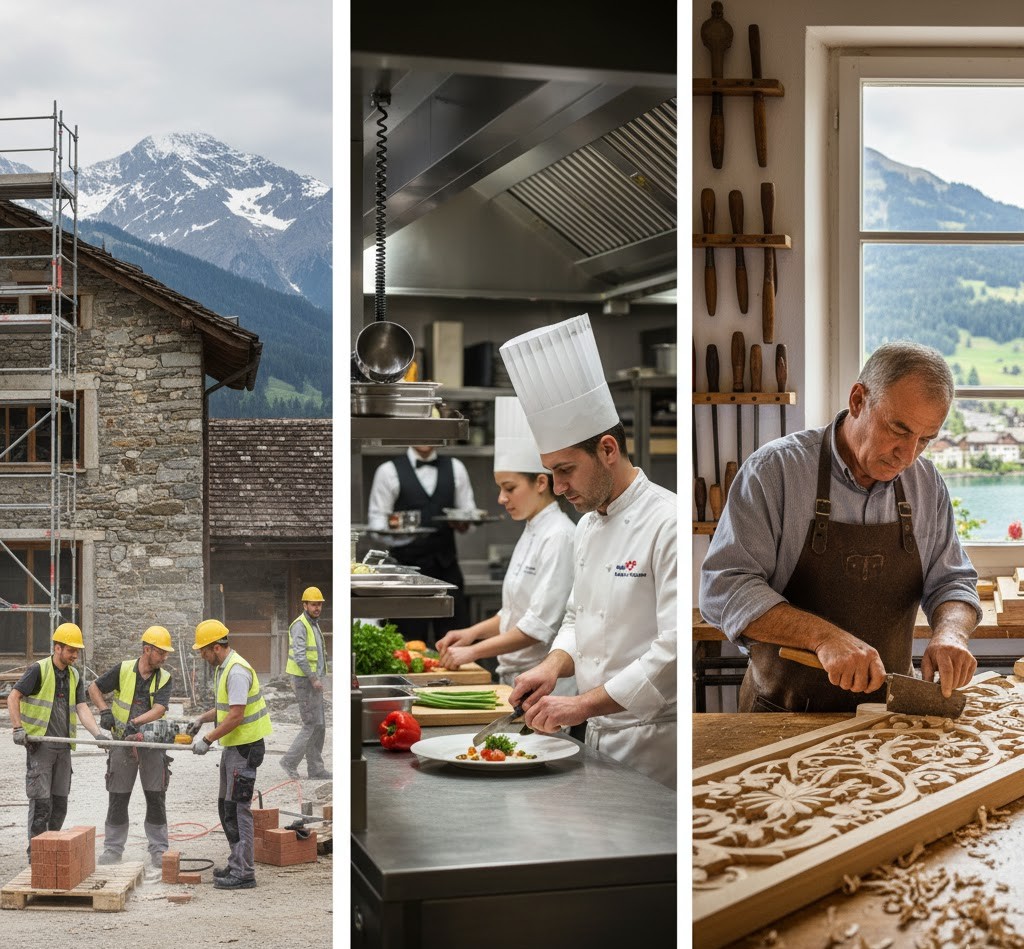
Crafts & Technical Services | Certified Plumber, Qualified Electrician, CNC Operator, Welder, Master Painter, Automotive Technician. |
Education & Social Services | Special Education Teacher, Kindergarten Teacher, Pediatric Nurse, Social Worker (Subject to high language proficiency requirement). |
Tourism & Gastronomy | Qualified Chef, F&B Manager, Hotel Receptionist, Housekeeping Supervisor (in tourist regions). |
Logistics & Administration | HGV Driver (CE Class/Heavy Goods), Warehouse Manager, Supply Chain Specialist, Executive Assistant (Multilingual). |
- Equivalency: The process of recognizing your diploma is important in these professions. For general facts about working in Switzerland, consult [WORKING AND LIVING IN SWITZERLAND: FACTS AND MYTHS].
3. Salaries and Economic Comparison: Who Earns What, Where?
Salaries in Switzerland exhibit significant variation depending on the canton, sector, education level, and even company size. The median gross monthly salary is CHF 6,788 (2022 FSO data).
3.1. Salary Distribution by Sector (Median Gross Monthly Salary, 2024 Estimates)
Sector | Median Salary (CHF) | High Range (CHF) |
|---|---|---|
Finance & Insurance | 10,500 | 15,000+ |
Pharma & Biotech | 9,800 | 13,000+ |
IT & Software | 9,200 | 12,000+ |
Engineering | 8,500 | 11,500 |
Salary Calculation Tool: To calculate your salary expectations in detail, referencing your sector and canton, you can use official tools like the Salarium Salary Calculator (Swiss Federal Statistical Office).
4. Working Conditions and Weekly Hours
Alongside high salaries, Switzerland is known for its regulated work culture and worker rights.
- Legal Working Hours: The weekly legal maximum working time varies: 45 hours/week for industrial, office, technical, and retail jobs. 50 hours/week for other sectors.
- Actual Hours Worked: The actual average weekly working time for full-time employees is around 40 hours.
- Annual Leave: The minimum statutory leave entitlement is 4 weeks (20 working days). Most corporations offer 5 or 6 weeks of leave.
Conclusion: Working in Switzerland necessitates more than high compensation; it demands strict rules, long-term commitment, and continuous learning. Aligning your conduct with the country’s expectations is the key to anchoring your career on solid ground.