Swiss Immigrant Rights and Obligations
focusAnaliz: From Residence Permit to Citizenship: Why Obligations Precede Rights
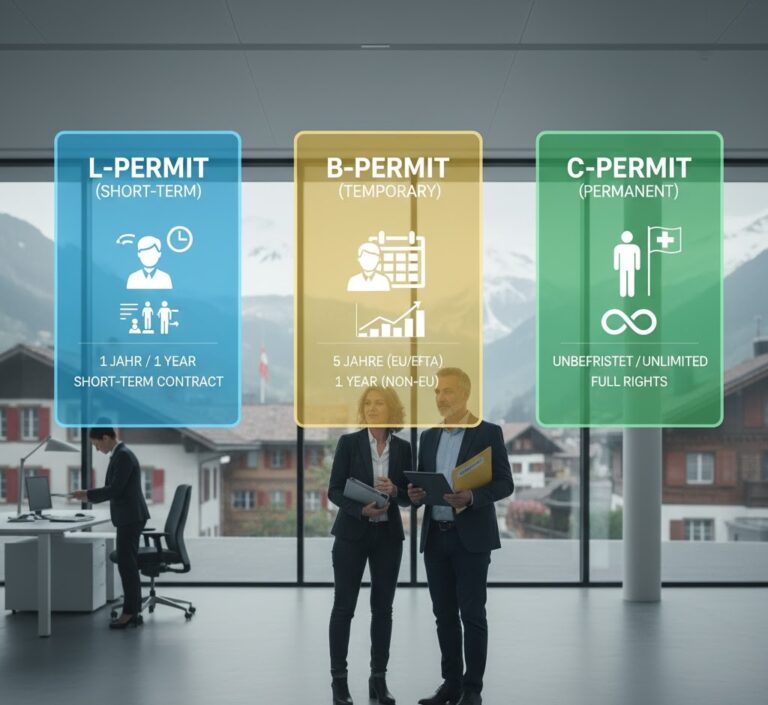
Immigrating to Switzerland is defined by a strict set of obligations as much as by the rights one obtains. All acquired rights (employment, social welfare, family reunification) depend on the type of residence permit held (L, B, or C). Therefore, to understand the basic source of your Swiss Immigrant Rights, one must first examine our article [Swiss Residence Permits (B, C, L): Which One Is Right for You?]. The Swiss Federal Act on Foreign Nationals (FNA) views integration not as a right but as an obligation.
In my personal observation, the Swiss system is “built on trust.” In applications for citizenship or the C permit (Permanent Residence), knowing the language is not enough. The system expects absolute adherence to laws and financial independence. The protection of your rights depends directly on how seriously you take your obligations. I welcome the requirement for language, and strongly recommend it. This is because language in Switzerland is the most important factor showing both your own rights and the path to social integration, and it is a topic that should be dwelled upon greatly.
Section I: The Source of Rights and Fundamental Obligations
Foreign nationals in Switzerland have rights based on their nationality and residence permit.
Fundamental Rights
- Social Security and Health: Everyone residing has the right to mandatory health insurance (KVG). Those with insufficient financial means can benefit from social assistance (However, reliance on social welfare negatively impacts the C permit application).
- Employment Rights: B and C permits grant the right to work freely throughout Switzerland (This is simpler for EU/EFTA citizens).
- Education: Children have the right to compulsory schooling (Schulpflicht).
- Family Reunification: B and C permit holders can bring their spouse and minor children under certain conditions.
Fundamental Obligations (FNA)
- Tax and Financial Discipline: Switzerland’s most critical obligation is financial discipline. Paying taxes, making regular insurance contributions, and being debt-free (having a clean Debt Enforcement Certificate, Betreibungsauszug) are essential. One of the most nonsensical issues for me is the excessive bureaucratic paperwork. For example, a debt enforcement certificate you obtain may expire in a week, or while everything about you is recorded here, constantly trying to gather separate documents from interconnected institutions is very meaningless.
- Legal Compliance: Absolute adherence to public order and safety is mandatory. Simply by showing respect for my surroundings and the society I belong to, I can compensate for the points where I cannot fully integrate; sometimes, I just gloss over the points that seem nonsensical to me. But by showing respect and fulfilling the requirement, I appear to accept this nonsense.
- Integration and Language: Foreign nationals are required to learn the official language of their region and adapt to Swiss social conditions and way of life. This is a mandatory requirement (FNA Art. 4).
Section II: Proof of Integration: The C Permit and the Path to Citizenship
The C Permit (Permanent Residence) and subsequent citizenship applications are the intersection point of immigrant rights and obligations.
Integration Criteria (FNA)
According to the Federal Act on Foreign Nationals (FNA), integration is assessed for foreign nationals to gain permanent status:
- Respect for Laws: Not violating public order and safety.
- Financial Independence: Not relying on social welfare and fulfilling financial obligations.
- Language Proficiency: Sufficient oral and written skills in the canton’s official language.
- Cultural Alignment: Respecting the values of the Swiss Constitution.
Local Integration Examples: Cantons demand integration in various ways. For readers planning to settle in Zurich or the capital, Bern, this process is vital: You can find these details in our articles: [BERN CANTON INTEGRATION GUIDE: LEGAL AND SOCIAL SUPPORT NETWORK] and [ZURICH CANTON INTEGRATION GUIDE: LEGAL AND SOCIAL SUPPORT NETWORK].
Section III: Social Obligations and Cantonal Differences
Despite the central Swiss federal laws, the application of rights and obligations varies significantly between cantons. This is a critical point emphasized in our article [10 Essential Facts You Need to Know Before Moving to Switzerland].
- Language Proficiency Levels: The language level required for the C Permit (A2/B1) can vary from canton to canton, and sometimes even municipality to municipality.
- Taxation: Since cantons set their own tax rates, your financial obligations will change depending on where you live.
Legal Source: The integration obligations of immigrants are detailed in the Swiss Federal Act on Foreign Nationals (FNA). (Source: Federal Act on Foreign Nationals (FNA) – Art. 4).
Conclusion: Swiss Immigrant Rights and obligations are a reciprocal agreement. The country offers you security, welfare, and a high quality of life; in return, it expects absolute compliance with rules, language learning, and financial independence. Maintaining this balance is the only formula for your long-term success in Switzerland.