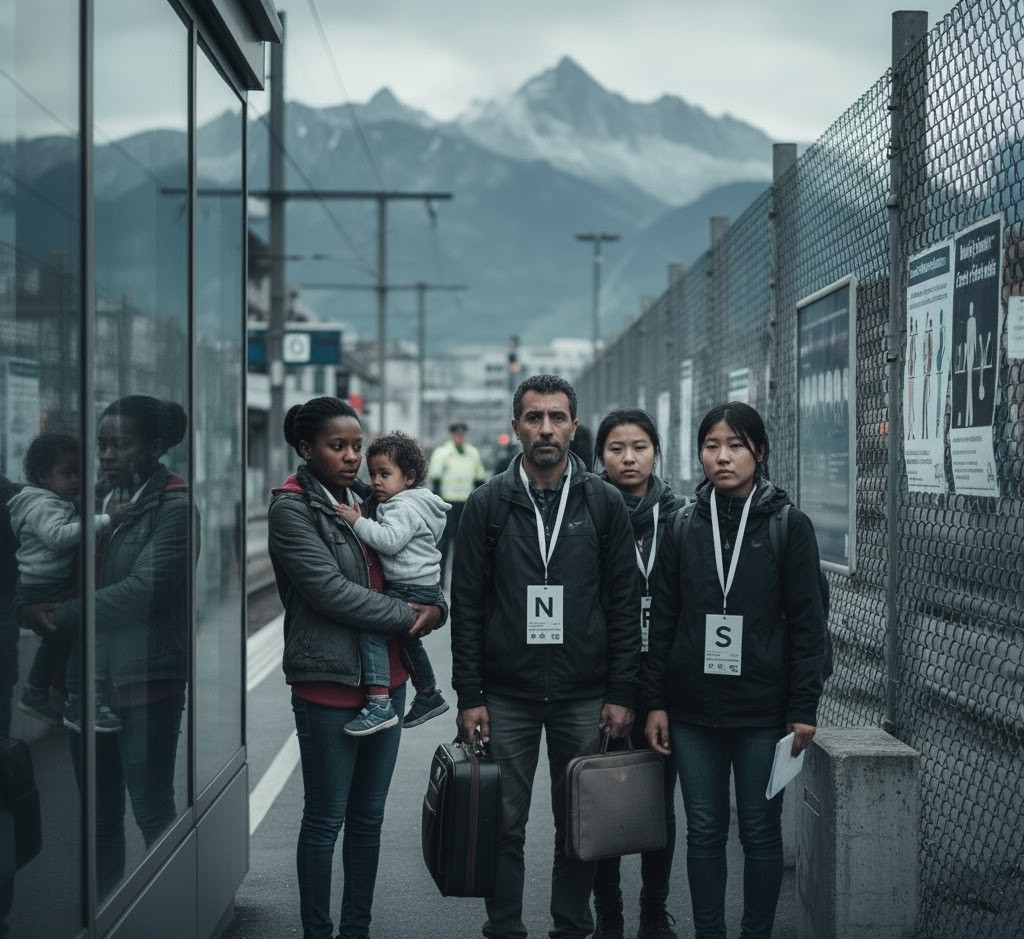
Swiss Asylum Statuses (N, F, S): Forced Migration and the Struggle to Cling to a New Life
focusAnaliz: Lives Abandoned, Perpetual Uncertainty, and the Cruel Classification of Statuses
Switzerland’s residence permit system responds not only to planned immigration. It addresses the most tragic reality of life: forced migration. This article examines the statuses (N, F, and S) granted to asylum seekers. These permits differ from L, B, and C. Ultimately, these permits are not merely legal documents. They are symbols of lives filled with uncertainty. These people abandon their birthplaces and come to a new land. They do this without knowing what awaits them, solely striving to cling to survival. Planning ends during this grueling period. Only the struggle for survival continues.
This is one of the hardest periods of life. Official authorities work diligently. Nevertheless, the restrictions imposed by these statuses put life on “pause.” These restrictions include work prohibition, a travel ban, and the need for constant renewal. The longest and most relentless process I have witnessed begins after seeking asylum in Switzerland. Trying to live without any income, apart from pocket money and covered expenses, is a process where decisions about your life are completely taken out of your hands. Let us examine what these three critical statuses (N, F, S) mean. We will also discuss the rights and obligations during this difficult time.
Section I: The Start of the Procedure: Application and N Permit (Asylum Seeker)
The asylum process in Switzerland begins at Federal Asylum Centers (Bündnis-Asylzentren). The N Permit (N-Ausweis) is the document granted to the applicant during this process.
The Relentlessness of the Process and Control
The asylum process in Switzerland completely transforms into a period where external actors house your life and make decisions for you over a long duration. Courts, judges, lawyers, aid organizations, and assigned individuals all participate. They examine your stories and decide if you can live in Switzerland. Officials are responsible for integration efforts and sending you to courses. Moreover, these assigned officials begin to make decisions entirely on your behalf. Consequently, personal autonomy is largely eliminated.
- Status and Meaning: The N Permit is not a residence permit. It is merely a document confirming that the person has applied for asylum and is awaiting a decision. It is the name of perpetual uncertainty. Furthermore, it is typically extended in 6-month periods.
- Work and Travel Restriction: Applicants cannot work in federal centers while the process is ongoing. After assignment to a canton, the right to work may arise. However, this is subject to cantonal permission and certain restrictions. Travel abroad is strictly prohibited. The SEM and UNHCR may grant permission for travel only in exceptional cases (e.g., serious illness).
- The Human Dimension: This is the most fragile phase. Asylum seekers cannot move between cantons. They await an uncertain future. Ultimately, their freedoms are largely restricted.
Section II: Provisional Admission (F Permit): Protection After a Rejection
The F Permit (Vorläufig Aufgenommene / Provisionally Admitted) is granted when the asylum application is rejected. This occurs when deportation is unlawful, unreasonable, or impossible (e.g., War, general violence).
- Status and Meaning: The F Permit is technically not an asylum status. It is a postponement of a deportation order. Although named “provisional,” the process can last for years.
- Right to Work: This status is better than the N Permit. F Permit holders have the right to work. Nevertheless, they must obtain permission from the canton. This is the first concrete step in the struggle to cling to life. Yet, the job search process remains restricted.
- Path to B Permit: F Permit holders can apply for the less restrictive B Permit after 5 years. They must demonstrate good integration to their canton. This transition is long and difficult. Crucially, it is at the discretion of the cantons.
- Rights and Obligations: Social benefits for those reliant on social welfare are lower than those paid to the local population. These can be up to 40% less in some cantons.
Section III: Refugee Status (B Permit) and the Permanent Goal (C Permit)
Individuals whose asylum application is accepted under the Geneva Convention are immediately granted a B Permit.
- Status Difference: Refugees granted a B Permit have the same rights as other B Permit holders. This fact significantly reduces uncertainty.
- Goal of Permanent Residence: These individuals can apply for a C Permit (Permanent Residence) after 5 years. They must prove good integration. This process requires the integration rules detailed in our article: Swiss Residence Permits (B, C, L): Which One Is Right for You?.
- Prohibition on Return to Home Country: Recognized refugees are prohibited from traveling to their country of origin. If they do, their refugee status may be revoked.
Section IV: Status S: Temporary Protection in Exceptional Circumstances (The Ukraine Example)
Status S (Schutzstatus S) is a special status. It was activated by the Federal Council’s decision (e.g., March 2022) to provide collective protection during times of war.
- Purpose: To provide fast, collective protection. It achieves this by bypassing standard asylum procedures.
- Rights: The situation is better for Status S holders. They are immediately granted the right to medical care, accommodation, and schooling for children. Most importantly, the right to work is immediately granted (subject to cantonal authorization). They can also travel freely within the Schengen Area if they have a valid passport.
- Validity: Status S is usually granted for one year. It can be extended up to a maximum of 5 years. After 5 years, if the protection status is not lifted, the person acquires the right to transition to a B Permit.
Conclusion: Switzerland’s asylum system manages immigration quality and fulfills international obligations. However, it also layers the stability and freedom of migrants according to their status. Ultimately, the process is not just a legal procedure. It is a test drive for thousands of people fighting for renewed existence. For instance, the N permit brings uncertainty. The F permit involves long waiting periods. Understanding this complex system is vital for accurately analyzing both the rights of asylum seekers and Switzerland’s human rights commitment. For more information, you can consult the official SEM website and UNHCR Switzerland guidelines.