Swiss Job Interview Strategies: Cultural Alignment, Competency Focus, and a Comprehensive Guide for Immigrants
focusAnaliz: Entry into the high-standard job market of the Swiss Confederation requires not only technical competence but also a deep alignment with the country’s entrenched professional cultural codes. Whether you are seeking a job as a highly paid finance expert or as a pizzaiolo, the fundamental expectation in this country is the same for everyone: Discipline and reliability. As a long-term resident of Bern, I know the immense value employers place on keeping even the simplest promises. This guide offers a strategic framework for immigrant candidates seeking to open the demanding professional doors of Switzerland, particularly those facing bureaucratic and cultural hurdles.
✅ Critical Data and Quick Facts
Criterion | Swiss Expectation | Consequence of Non-Compliance | Immigrant Challenge |
|---|---|---|---|
Punctuality | Be ready 5–10 minutes before the appointment. | Perceived as lack of discipline/unreliability. | Misunderstandings due to unfamiliar mobility culture. |
Communication Style | Intense eye contact, rational and direct speech. | Suspicion of insincerity or lack of competence. | Culturally varied norms for eye contact. |
Document Architecture | Submit all references as a single PDF file. | Organization deficit, perceived as lack of seriousness. | Lack of the standardized Swiss Employment Reference (Arbeitszeugnis). |
Question Format | Answer Competency-Based Interview (CBI) questions with concrete examples. | Hypothetical or emotional answers are insufficient. | Framing past experiences according to Swiss standards. |

🎯 Core Definition
Swiss job interview strategies constitute a competency-based and rational process, demanding that candidates prove their technical competence through a deep alignment with the core Swiss work culture values of predictability, reliability, and efficiency.
✅ Essential Information: The Core Codes of Swiss Professional Culture
Understanding the cultural expectations in Swiss business life is as crucial as possessing technical skills.
🏛️ The Sanctity of Punctuality: The First Proof of Trust
In Switzerland, punctuality is a professional necessity that goes beyond international standards, often regarded as an almost “sacred” value.
- This strict sense of time serves as a primary behavioural measure of the candidate’s professional discipline and organizational skills.
- A local saying, even adopted in the French-speaking regions, summarizes this precision: “Avant l’heure, c’est pas l’heure, après l’heure, c’est plus l’heure” (Before the time is not the time, after the time is not the time anymore).
- Being late is automatically interpreted by the employer as “poor discipline or inefficiency.”
⚠️ MUST DO: Arrive exactly 5–10 minutes before the appointment. If you arrive too early, wait quietly and prepared. Find Information on the strict business ethics in the French and German-speaking regions here.
🤝 Nonverbal Communication: Controlled Attention and Sincerity
Nonverbal communication during the interview silently reveals the candidate’s intent and character.
- Intense Eye Contact: The critical way to strengthen sincerity and trust is by maintaining continuous and intense eye contact with the interviewers.
- Minimalism: The Swiss prefer to minimize gestures and physical contact. Excessive gesticulation may be perceived as emotional overstatement in a professional setting.
❌ AVOID: Crossing your arms (a sign of disagreement), keeping hands in pockets, or using the American OK sign (thumb and index finger forming a circle), as it is strictly considered an obscene gesture in Switzerland.
✅ Detailed Guide: Interview Strategies and Technical Requirements
📄 Swiss CV and Reference Package Architecture
The corporate order in Switzerland is reflected in great care for document management.
- The Single PDF Rule: All references, diplomas, and certificates (excluding the CV) must be chronologically ordered, starting with the most recent, and consolidated into a single PDF file.
- Framing International Qualifications: When listing a foreign degree, it is essential to explain what it means according to Swiss standards or equivalence.
- Language Skills: All language proficiencies must be clearly stated.
🔍 Management of the Reference Check Process
Comprehensive reference checks are common in Switzerland, especially before a job offer is made.
- Expectation: Ensure that your references (former employers, academic institutions) are ready and informed.
🧠 Competency-Based Interviews (CBI) and the STAR Method
The predominant format is the Competency-Based Interview (CBI). These questions demand concrete examples from the past of how the candidate managed a specific situation or challenge. Answers should be structured using the STAR Method (Situation, Task, Action, Result).
- Goal: Employers seek concrete actions and results—not hypothetical answers—that prove the candidate’s reliability and consistency.
⭐ Sample STAR Answer Blocks (CBI)
Example 1: Conflict Resolution (Leadership Role)
- Situation (S): Two of my team members (sales and operations) were in constant conflict over differing priorities, jeopardizing a critical project deadline.
- Task (T): My duty was to resolve the conflict and ensure the project was delivered on schedule.
- Action (A): I spoke to both sides individually, then brought them together, establishing common ground by visualizing how both departments served the main company objective.
- Result (R): The conflict was resolved, the deadline was met 2 days early, and team collaboration improved significantly afterwards.
❓ Strategic Questioning by the Candidate
Asking questions is encouraged and mandatory in Swiss job interviews.
- Strategic Questions: Prepare 3–4 questions about the typical daily tasks of the role, the main challenges faced by the previous employee, or the skills the company considers most important.
- To Avoid: Avoid bringing up topics like salary and vacation in the early stages of the process.
✅ focusAnaliz: The Cost Gap and Negotiation Power
Salary negotiation is an expected part of the Swiss job market. According to Core Rule IV.1, the cost gap comes into play here:
- Highly Qualified: For highly qualified candidates, an increase between 4% and 12% compared to the previous salary can be targeted.
- Minimum Wage Sectors: While the negotiation margin is narrower for immigrants in minimum wage sectors (kitchen, cleaning, etc.), it is not impossible. Concrete achievements proving high efficiency can justify a well-founded salary adjustment. Read our articles for a Salary Analysis. It is mandatory to include the lowest-wage sectors in economic comparisons.
✅ Step-by-Step Guide: Risk Management for Immigrants
- Position Yourself as Irreplaceable: As a Third-Country National (Non-EU/EFTA), you must position yourself as a rare, critical specialist to circumvent the Precedence Rule. Find Official information on employment conditions for third-country nationals here.
- Justify Uniqueness: Detailed justification of why your niche skills and international experience are vital for the company’s global objectives is required during the interview.
- Transparency on Permit Status: Be transparent and informed about your Work Permit Status. Show that you are familiar with the Guide to Residence Permits and are willing to accelerate the process. Consult Official information on legal provisions and restrictions on this page.
- Managing the AZ Hurdle: To mitigate suspicion caused by the lack of a standardized Arbeitszeugnis (AZ), submit all international certificates and reference letters neatly in a single PDF file.
✅ Pre-Interview Checklist
Check these 10 items before leaving the house to guarantee your interview success:
- 📄 Single PDF File: Are your CV, diplomas, and references chronologically consolidated into one PDF?
- 🧭 Transport Plan: Has the route been checked via the SBB Mobile App, including a backup plan to guarantee arrival 15 minutes early?
- 💼 Attire Check: Is your attire professional, clean, and modest (avoid excessive display)?
- 📜 Reference Preparation: Are the contact details of 1–2 referees ready in case the interviewer requests them?
- 🔎 Company Research: Do you have 2–3 concrete facts about the company’s recent projects and core values?
- ❓ Strategic Questions: Are 3–4 in-depth questions about the role prepared (excluding salary questions)?
- 💬 Status Note: Do you have a clear, honest, and positive statement prepared to explain your permit status?
- ⭐ STAR Answers: Do you have 2–3 STAR-formatted answers prepared for the toughest CBI questions?
- ⏳ Punctuality Margin: Have you left home to arrive exactly 5–10 minutes before the appointment?
- 📞 Necessary Phones: Is a phone (on silent) with you for emergencies?
✅ Cost / Time Table
Criterion | Relevant Section | Duration/Amount/Rate | Impact |
|---|---|---|---|
Punctuality Margin | Section I | 5–10 minutes before the appointment | Proof of Reliability |
Target Salary Increase | Section IV | 4% to 12% (for job changers) | Negotiation range. |
Hidden Market Rate | Section V | 60% to 80% (unadvertised positions) | Necessity of Networking. |
Non-EU Applicant Difference | Section V | 30% more applications required | Employers filtering foreign candidates more strictly. |

SSS
Q: What is the “Arbeitszeugnis” (AZ) and why is it important?
Answer: The AZ is an official and meticulously coded reference letter from previous employers. It is considered the most important proof of a candidate’s past performance and work ethic in Switzerland.
Q: When should I negotiate salary?
Answer: It is unprofessional to bring up salary in the first interview. Negotiations should be postponed to the later stages, when a job offer is imminent.
Q: How should I answer questions about my permit status?
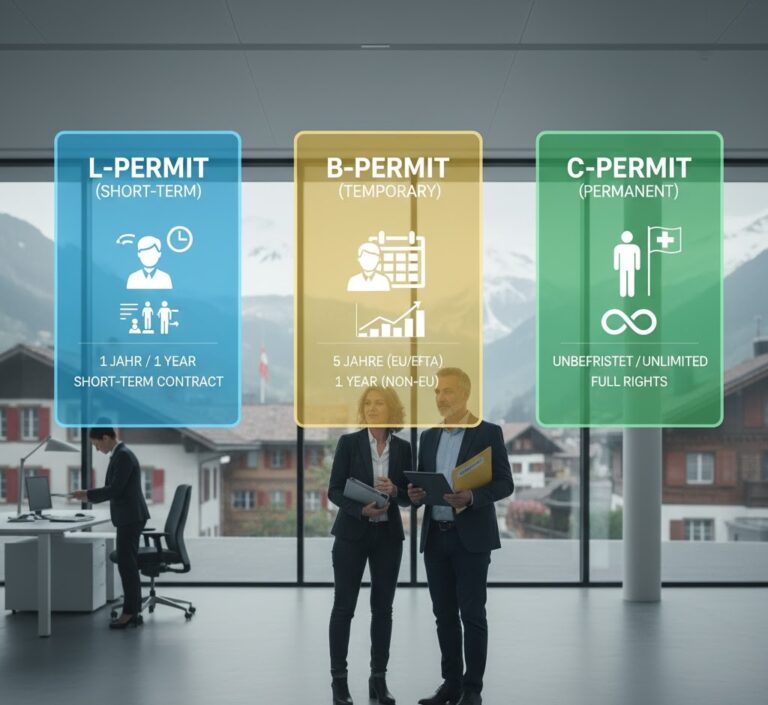
Answer: You must be transparent and well-informed. Show that you are aware of the restrictions of your permit type (B, C, L) and willing to facilitate the administrative process.
✅ Alternatives
- Negotiation Alternative: If a salary agreement cannot be reached, you can try negotiating additional perks such as annual bonuses, extra vacation days, or a budget for professional development.
- Access Alternative: Don’t limit yourself to LinkedIn for accessing the hidden job market. Focus on expanding your network via platforms like Arbeit.swiss or Jobs.ch and requesting informational interviews.
✅ Recommendations / Tips
- Stay Rational: Remain factual and objective during negotiation. Avoid becoming emotional or making threats.
- Terminology: Use the term “salary adjustment” instead of “salary increase” to frame the demand as a justified correction.
- Cultural Note: Check the route via the SBB Mobile App before the interview to guarantee punctuality. Punctuality is the easiest trust point to earn.
✅ Conclusion
The Swiss job interview is a demanding process that requires cultural alignment, rational preparation, and competency-based evidence. Success hinges not just on what you know, but on how well you reflect the fundamental Swiss values of discipline and reliability.
Prepare your documentation meticulously and position yourself as an indispensable resource in the market. If you found this guide helpful, please share it to help other immigrants starting their career journey!