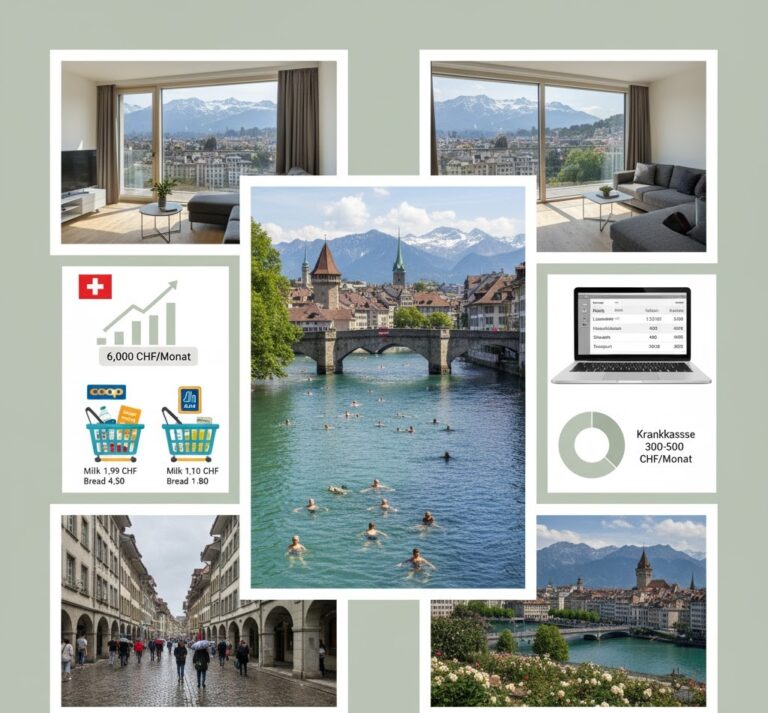
MINIMUM WAGE AND AVERAGE SALARY IN SWITZERLAND: REALITIES AND ILLUSIONS
focusAnalyse: The Invisible Cost of Being ‘Minimum Wage’ in Rich Switzerland
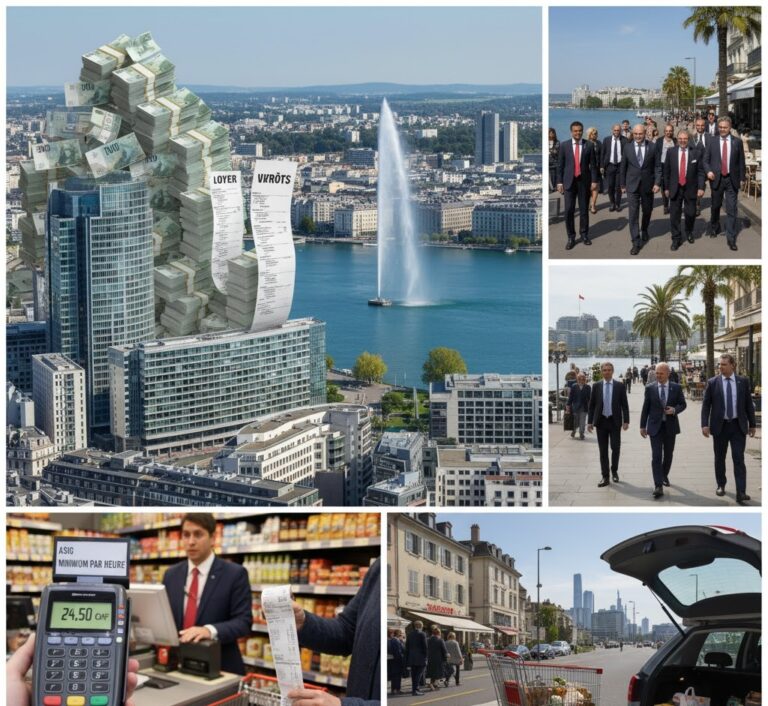
Switzerland is generally cited as the country with the highest salaries in the world. However, these high figures are an illusion that hides the real wage structure and the low-wage trap faced particularly by immigrants. There is no national minimum wage in Switzerland, which creates significant uncertainty at the lower end of the wage spectrum.
In my observation, this article critically examines the difference between median and average salaries and what cantonal minimum wages truly mean against the backdrop of high living costs. In my opinion, the biggest reality contradicting Switzerland’s perception of wealth is that a gross salary of 4,000–4,500 CHF in high-cost cities (Zurich/Geneva) often means constant budget restriction and the risk of a social assistance trap, rather than an enjoyable life by the lake.
✅ Quick Summary Table
Criterion | Median Salary Earner | Cantonal Minimum Wage Earner (Low Income Group) |
|---|---|---|
Monthly Gross Income (2025 Context) | ~6,788 CHF (BFS Data 2022) | ~4,455 CHF (Geneva, Current 2025) |
Critical Expense Ratio | 25%–35% for Rent and Insurance | 45%–55% for Rent and Insurance (bare existence) |
Purpose of Minimum Wage | Raising the wage average | Preventing the Working Poor problem |
Financial Freedom | High | Very Low / Limited Scope for Movement |
🎯 Main Definition:
The high average salary in Switzerland (median 6,788 CHF) is an illusion that conceals the low purchasing power trap created by cantonal minimum wages (e.g., Geneva 4,455 CHF) when juxtaposed with mandatory fixed costs (rent, KVG); this situation contradicts the country’s perception of prosperity and is a reality that must be confronted.
✅ Essential Information: The Average Salary Illusion and Cantonal Realities
To understand Switzerland’s wage structure, one must look beyond the misleading average salary figures.
📊 Why the Median Salary is More Important
Search engines and international reports often show the average monthly gross salary in Switzerland to be between 6,665 CHF and 6,900 CHF.
- Median Reality: To see the true picture, we must look at the median salary. The median indicates the income exactly in the middle of the wage scale. According to the Federal Statistical Office (BFS) data, the median gross income of full-time employees is around 81,500 CHF annually (about 6,800 CHF monthly).
- Source: [BFS Lohnstrukturerhebung (LSE) 2022]
- To understand what these salaries mean against high rents, health insurance, and other mandatory expenses, you can review our article on rental prices in Switzerland.
💰 The Reality of Low Wages: Cantonal Minimum Wages (Current 2025)
Due to Switzerland’s federal structure, there is no minimum wage determined at the federal level.
Canton | Gross Minimum Wage per Hour (Current 2025) | Monthly Gross Approx. (42 Hours per Week) | Note (focusSwiss Analysis) |
|---|---|---|---|
Geneva (GE) | ~24.48 CHF / hour | ~4,455 CHF | One of the highest minimum wages globally; attempts to balance high living costs. |
Basel-Stadt (BS) | ~22.00 CHF / hour | ~4,004 CHF | Provides minimum wage assurance in an important economic hub. |
Ticino (TI) | ~20.01 CHF / hour | ~3,642 CHF | Region near the Italian border where the cost of living is comparatively lower. |
Zurich, Bern, Vaud, etc. | No national/cantonal minimum wage | Variable | Salaries depend on sectoral Collective Labour Agreements (GAV) or employer initiative. |
- Critical Point: A gross monthly salary of 4,455 CHF in Geneva is barely enough to get by, considering high rents and insurance premiums. This cantonal minimum wage data is regulated by the [Geneva Canton Official Labour Law].
✅ Detailed Guide: Wage Gap and Financial Constraints
Wage inequality in Switzerland is evident not only between cantons but also between sectors and genders.
⚖️ Wage Gap Between Sectors and Genders
- Gender Pay Gap: BFS data clearly shows the median income difference between women and men. The median income of full-time employed men is approximately 12% to 14% higher than that of women.
- Source: [BFS Analysis of the Gender Wage Gap]
- Sectoral Difference: Salaries in the Finance and IT sectors can be up to three times higher than those in Gastronomy, Cleaning, and Agriculture. This increases the risk for immigrants to fall into the “Working Poor” category.
🚌 Mobility with Low Income (Transport Costs)
Low-wage earners are forced to seek more affordable housing away from high-cost city centres (Zurich, Geneva).
- This increases daily commuting costs and time. To understand the cost and strategies of public transport with a low salary, it would be helpful to review our article on public transport in Switzerland.
🏡 Housing and Health Insurance Pressure
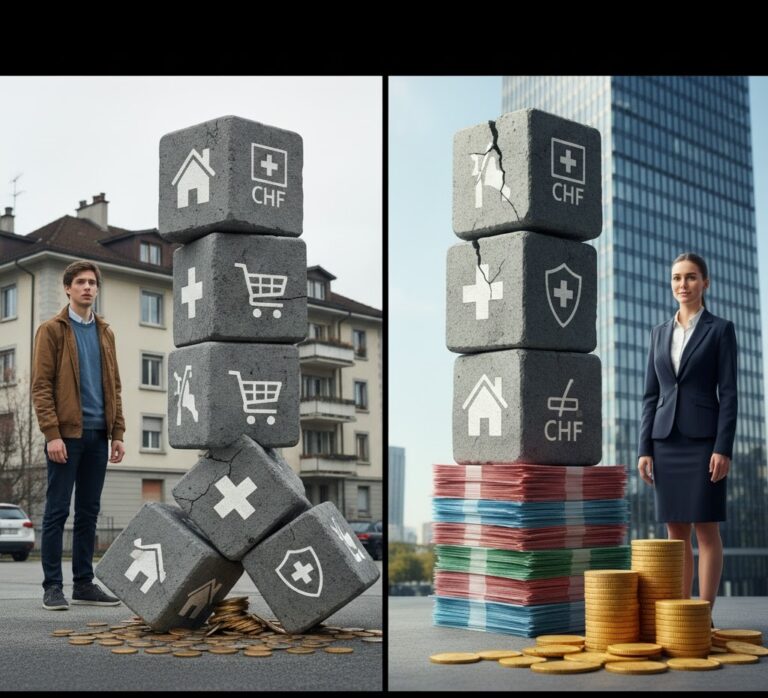
Rent and KVG (Health Insurance) premiums are the largest fixed expenses in Switzerland. In low-income groups, these expenses consume 45%–55% of the income. As seen in our previous article ([Monthly Expense Table for Two Different Income Groups]), this income bracket leaves very little room for savings.
✅ Experience / Recommendation Section: Low Wage Reality in Gastronomy in Bern
focusAnalyse: What Remains When Salaries Melt Away?
As a chef and pizzaiolo living in Bern, I personally observe the wage reality in GAV-regulated sectors like Gastronomy and cleaning. Although there is no federal minimum wage in Bern, the base salary is around 4,000 CHF thanks to GAVs. My personal observation is that when 1,200 CHF goes to rent, 350 CHF (even with a reduction) goes to KVG health insurance, and 150 CHF goes to transport, the remaining amount is definitely not enough for an enjoyable life in Zurich or Bern.
My personal advice: If you are offered a gross salary of 4,500 CHF upon arrival in Switzerland, do not accept the figure immediately. If you will be required to live in high-cost cities (Zurich or Geneva), take seriously the risk that this salary will push you into the “Working Poor” category. True financial success lies not in the height of the salary, but in the low level of the mandatory expenses.
Step 1: Calculate Living Costs at the Cantonal Level
Acknowledge that there is no federal minimum wage and check the legal minimum wage of the canton where you plan to work. If there is no cantonal minimum wage, find the GAV for your sector.
Step 2: Keep Expenses Below 50% of Income
Aim for at least 50% (preferably 60%) of your salary to remain outside fixed expenses (rent, insurance, tax). This is only possible by seeking more affordable housing in rural areas.
Step 3: Learn Your Social Rights (Premium Reduction)
If you have a low income (especially around the cantonal minimum wage), immediately inquire about your right to KVG health insurance premium reduction (Prämienverbilligung). This will save you hundreds of francs in fixed expenses.
Step 4: Financial Chasm Analysis
Before starting work, get a clear picture of the low-wage trap in high-cost cities and arrive with a financial cushion.
✅ Cost / Fee / Duration Table
This table illustrates the net situation of an individual earning the Geneva minimum wage against high costs.
Item | Geneva Minimum Wage (Gross ~4,455 CHF) | Percentage Ratio (of Income) | Note |
|---|---|---|---|
Mandatory Rent Expense | ~1,300 CHF (One-room, outskirts) | ~29% | Ideal limit should not exceed 25% of net income (Regulation). |
Mandatory KVG Insurance Premium | ~350 CHF (Reduced, without social help) | ~8% | KVG premiums are higher in Geneva than, for instance, in Bern. |
Mandatory Tax/SV | ~500 CHF (Withholding tax deduction) | ~11% | Social Insurance and Withholding Tax (Net income is around 3,955 CHF). |
Total Fixed Expenses | ~2,150 – 2,450 CHF | ~48% – 55% | Remaining budget is around 2,000 – 2,300 CHF. |
Net Remaining (Savings/Food) | ~2,000 CHF | N/A | This amount must cover food, clothing, telecommunications, and all holiday/entertainment expenses. |
❓ Frequently Asked Questions (FAQ)
❓ If there is no national minimum wage in Switzerland, how much must the employer pay me?
The employer must set your salary according to the “customary conditions for the region and profession.” If your sector is under a Collective Labour Agreement (GAV), this agreement sets the minimum salary. If there is no GAV, the salary is freely determined, but being excessively low can legally cause difficulty.
❓ What does being Working Poor mean?
Working Poor refers to an individual who, despite being employed full-time, barely rises above or falls below the poverty line because their earnings only just cover basic living costs (especially rent, KVG). This is common among low-wage immigrants in Switzerland.
❓ Why is the median salary more reliable than the average salary?
In my opinion, the median salary is more reliable because it shows the exact midpoint of the salary distribution. The average (mean) salary can be skewed upwards by high-earning CEOs or Finance professionals and does not accurately reflect the income level of the general population.
✅ Alternatives: Strategies to Escape the Low-Wage Trap
- Geographic Strategy: Avoid cities with high cantonal minimum wages but also high living costs (Zurich, Geneva, Basel-Stadt). Settle in more affordable neighbouring cantons and commute.
- Side Hustle: If your salary is low, explore legal ways to earn supplementary income in Switzerland.
- GAV Mandate: If possible, seek jobs in sectors where salaries are protected by Collective Labour Agreements (GAV).
✅ Recommendations / Tips
- Inquire about KVG Reduction: If your income is low, immediately inquire about your right to the KVG premium reduction (Prämienverbilligung). This saves hundreds of francs annually.
- Balance Transport Costs: If you move away from high-cost centres, evaluate public transport benefits like the Swiss Travel Pass for commuting.
- Rent 25% Rule: Try not to spend more than 25% of your net salary on rent. Otherwise, you risk severe financial strain.
✅ Conclusion: Purchasing Power and the Low-Wage Trap
High salaries in Switzerland only boost the country’s average income; they do not reflect the prosperity of all employees. Financial success for a low-wage immigrant in Switzerland depends on the ability to keep rent and health insurance premiums at the absolute lowest level. This is a reality that clashes with the perception of national prosperity and must be faced.
Take Action: If you are struggling to live on the cantonal minimum wage in Switzerland or have escaped this trap, share your biggest savings strategy in the comments to provide a concrete roadmap for other readers!