🏔️ Riding the Swiss Rails: A Survival Guide to Not Breaking the Bank (2026)
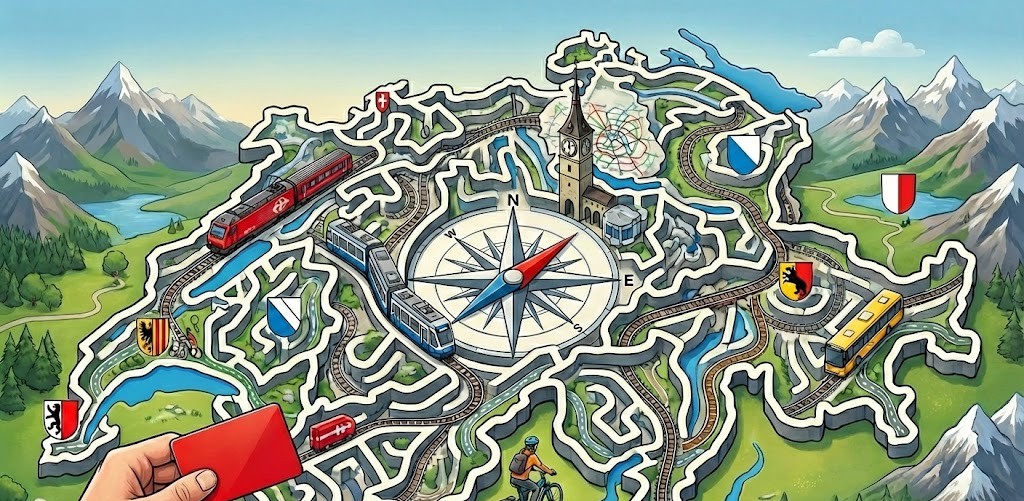
I still remember my first day landing at Zurich Airport. Standing in front of those massive blue SBB screens, staring at terms like “Zone 110” and “Point-to-Point,” I felt like I was solving a complex calculus equation just to get to my apartment. “Why is a three-stop ride the price of a fancy meal?” I wondered.
Fast forward 10 years, and those machines are now my best friends. But I know that for a newcomer or a visitor, the Swiss transport system looks like a beautiful, expensive maze. So, grab a coffee, and let’s break down the 2026 transport costs across the cantons—local to local.
1. The Golden Rule: The “Halbtax” (Half-Fare) is Not Optional
In Switzerland, if you don’t have a Halbtax card, you’re either a billionaire or you arrived yesterday.
- What is it? You pay CHF 190 per year (thankfully, prices held steady in 2026), and suddenly, every train, bus, boat, and tram in the country is 50% off for you.
- Pro Tip: Even if you think “I don’t travel much,” two round trips from Zurich to Bern will pay for the card. Buying a full-price ticket in this country is essentially paying a “newcomer tax.” Don’t do it.
2. The Battle of the Cantons: Who Has the Best Deal?
Every canton operates like its own little republic when it comes to pricing. Here is how the big players stack up in 2026:
| City (Canton) | The Vibe | Monthly Pass (Adult, Full) | The “Expats” Perspective |
| Geneva (GE) | French Ease | ~CHF 70 | The most merciful prices. It’s compact and bus-heavy. |
| Zurich (ZH) | German Precision | ~CHF 87 | Expensive, but a tram arrives every 2 mins. Like clockwork. |
| Bern (BE) | The Middle Ground | ~CHF 79 | Home of the iconic yellow buses. Reliable and fair. |
| Lausanne (VD) | The Hill Climber | ~CHF 74 | Thank God for the metro; your knees wouldn’t survive the hills. |
| Zug (ZG) | The Tax Haven | ~CHF 65 | Cheapest in the lot, but good luck finding an apartment there! |
My Observation: In Zurich, if a tram is 60 seconds late, people start checking their watches with visible frustration. In Geneva or Ticino, there’s a bit more “Mediterranean soul”—a minute or two doesn’t hurt anyone. The prices often reflect this intensity of service.
3. “EasyRide” & The SBB App: Your Digital Conductor
Forget fumbling with coins at a machine. Download the SBB app, link your card, and use EasyRide.
- How it works: You swipe “Start” when you board and “End” when you hop off. The system tracks your journey via GPS and bills you the cheapest possible fare at the end of the day.
- Word of Caution: Keep your phone charged! If your battery dies and a controller walks in, saying “My phone died, officer” results in a very polite, very Swiss CHF 100 fine.
4. Micro-Mobility: E-Bikes are Your Secret Weapon
In 2026, e-bikes (like PubliBike or Pick-e-Bike) are everywhere.
- The Local Trick: While a 30-minute ride costs about CHF 5, get the annual subscription if you live in a city like Basel or Lausanne. Zipping past traffic by the lake on a summer morning is a feeling of freedom that no tram can match.
5. The Hidden Gem: “Gemeindetageskarte”
Most newcomers miss this. Go to your local town hall (Gemeinde) or check their website. They sell a limited number of “Day Passes” that let you travel anywhere in Switzerland for the whole day for around CHF 40-45. If you have friends visiting, this is the cheapest way to show them the Alps without crying when you see the bill.
Final Word: Transport is a Culture, Not Just a Ride
Traveling in Switzerland is about respecting the “unspoken code”:
- The Quiet Zone: If you see the “S” or “Silent” sign in a train carriage, whisper. Taking a loud phone call there is the ultimate social sin.
- The Greeting: Always say “Grüezi” or “Bonjour” to the bus driver. It’s the Swiss way.
- Trust, but Verify: There are no turnstiles. The system trusts you to have a ticket. But don’t break that trust—the fines are steep, and the “Social Control” is real.