Swiss C Permit Requirements and the Path to Citizenship: Long-Term Living Guide
focusAnaliz: Balancing the Speed and Cost of the Process
The ultimate goal for every individual immigrating to Switzerland is typically to obtain a permanent status. The Swiss C Permit Requirements and the path to Citizenship are not merely about the duration of stay. Instead, they are the official proof of how well an individual has integrated into the cultural and legal fabric of Switzerland. The C Permit (Niederlassungsbewilligung) grants the right to reside indefinitely, while Citizenship (Einbürgerung) provides full political rights and permanent security.
In my personal observation, success in this journey lies in balancing the process’s complexity with its duration. Furthermore, Switzerland does not grant this right generously. On the contrary, it is uncompromising on financial independence, language proficiency (especially B1 and B2 levels), and a clean legal record. This guide will detail the clear steps and critical conditions required to achieve the goal of obtaining the Swiss C Permit Requirements and Citizenship.
Section I: What is the C Permit (Permis C) and How to Obtain It?
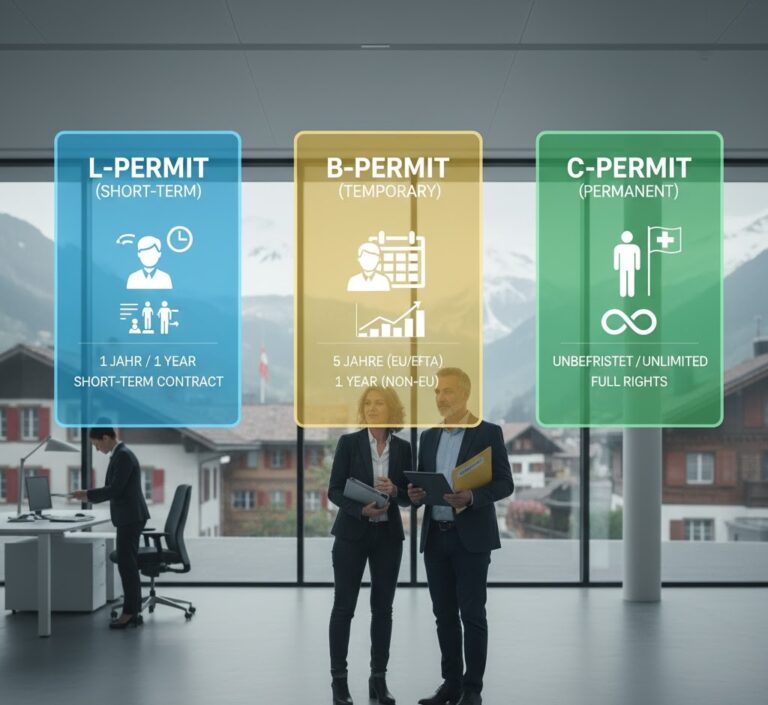
The C Permit signifies the right for immigrants to reside in Switzerland indefinitely and unconditionally. The transition from a B permit to a C permit primarily follows two routes: the Standard Procedure and the Simplified Procedure. Crucially, the differences and rights associated with these permits are summarized in our article Swiss Residence Permits (B, C, L): Which One Is Right for You?.
1. Standard C Permit Procedure
- Time Requirement: Non-EU/EFTA (Third-Country) nationals must have 10 years of continuous legal residence in Switzerland. Additionally, the last 5 of these years must have been spent with an uninterrupted B permit.
- Application Details: The application is submitted to the cantonal Migration Office (Migrationsamt) in the 8th or 9th year.
2. Integration and Swiss C Permit Requirements (Key Criteria)
- Language Proficiency: Proof of at least A2 written and B1 oral proficiency in the official language of the canton of residence is mandatory.
- Financial Status: Not being dependent on social welfare and having a stable income are essential.
- Legal Cleanliness: Having a clean criminal record and a clean debt enforcement record (Betreibungsauszug) is required.
3. Simplified C Permit Procedure (Early Application)
The Foreign Nationals and Integration Act (AIG) offers the possibility of obtaining the C Permit early:
- Time Requirement: Only 5 years of uninterrupted residence.
- Conditions: The applicant must prove exceptional integration. This includes knowing the cantonal language at a B1 written and C1 oral level, fully adapting to the Swiss way of life, and being completely financially independent. Consequently, this procedure has extremely strict criteria.
Section II: The Path to Swiss Citizenship
The C Permit is a prerequisite for applying for Citizenship. Swiss Citizenship (Einbürgerung) requires approval at three different levels: Confederation, canton, and municipality.
1. Standard Naturalization Procedure
- Time Requirement: Having resided in Switzerland for a total of 10 years. Furthermore, each year between the ages of 10 and 20 counts double towards this 10-year total.
- C Permit: Having a valid C permit at the time of application is mandatory.
- Integration:
- Language Proficiency: Proving at least B1 oral and A2 written level in the cantonal language (a lower level than the simplified C permit procedure).
- Cultural Alignment: Respecting Swiss traditions, way of life, and constitutional order.
- Financial Cleanliness: Having fully fulfilled tax and debt obligations.
2. Simplified Naturalization Through Marriage
If an individual has been married to a Swiss citizen for at least 3 years and has lived in Switzerland for a total of 5 years, then they are exempt from the 10-year requirement of the Standard Procedure. Conditions still focus on language and integration, but the process is more centralized (SEM).
Section III: Permanent Integration and Obligations
In both C Permit and Citizenship applications, the applicant must demonstrate “successful integration into Swiss society.” This topic is covered in detail in our article Swiss Immigrant Rights and Obligations.
Local Integration Examples: The Cantonal Factor
The cantons require integration in various ways. For instance, for readers planning to settle in Zurich or the capital, Bern, this process is vital: You can find these details in our articles BERN CANTON INTEGRATION GUIDE: LEGAL AND SOCIAL SUPPORT NETWORK and ZURICH CANTON INTEGRATION GUIDE: LEGAL AND SOCIAL SUPPORT NETWORK.
Integration Criterion | C Permit (Min.) | Citizenship (Min.) | Explanation |
|---|---|---|---|
Language | A2 Written / B1 Oral | A2 Written / B1 Oral | The official language of the canton of application is used. |
Legal | Clean criminal record | Clean criminal record | Accepting and adhering to the legal order. |
Economy | Not reliant on social welfare | Not reliant on social welfare | Being economically self-sufficient. |
Bureaucracy and Acceptance: One of the most nonsensical issues for me is the excessive bureaucratic paperwork. For example, a debt enforcement certificate you obtain may expire in a week. Or, while everything about you is recorded here, constantly trying to gather separate documents from interconnected institutions is very meaningless. However, simply by showing respect for my surroundings and the society I belong to, I can compensate for the points where I cannot fully integrate. Ultimately, by showing respect and fulfilling the requirement, I appear to accept this nonsense.
Legal Source: Immigrants’ integration obligations are detailed in the Swiss Federal Act on Foreign Nationals (FNA). (Source: Federal Act on Foreign Nationals (FNA) – Art. 4).
Conclusion: The Swiss C Permit Requirements process is more than a legal formality; it is the confirmation of a decade-long social contract made with Switzerland. Success is achieved not merely by fulfilling the time requirement, but by maintaining the trinity of financial discipline, language skills, and social participation. I welcome the language requirement and strongly recommend it. This is because language in Switzerland is the most important factor showing both your own rights and the path to social integration. Plan early and prepare for this long-distance race.