Working and Living in Switzerland: Facts and Myths
focusAnaliz: High Salaries, Hidden Costs, and the Bureaucratic Fork
Welcome to Switzerland! This is a land famous not only for the punctuality of its clocks but also for salaries that grace the dreams of financial geniuses. However, a warning: when applying for a serious career, never staple your visa forms; Swiss bureaucracy values aesthetics more than you do. Furthermore, if you drop your bread while eating cheese fondue, you risk instant trial by the “Fondue Court.” This is the guide that deciphers the fine line behind high prosperity, covering all the realities—from financial feasibility to the codes of cultural adaptation.
I. MYTH: HIGH SALARIES AUTOMATICALLY LEAD TO HIGH PROSPERITY
The average monthly gross salary in Switzerland is around CHF 6,665 as of 2024 (peak level approx. CHF 6,910/month), making the country a global leader in wages. However, two unique cost components of Swiss life instantly erode this nominal power.
Fact 1: Survival on Minimum Wage is Possible, But Real Savings Require Two Incomes
While there is no federal minimum wage in Switzerland, some cantons set their own floor wages.
The country’s highest minimum wage is paid in Geneva, approximately CHF 25 per hour (gross monthly approx. CHF 4,875). Calculations show that even a single person without children can get by without financial issues on this salary, even having a small surplus of around CHF 160 per month.
The Formula for Prosperity: Real savings and prosperity in the face of high living costs are achieved through a dual-income model, where both partners work. A large portion of the second salary entering the household creates a strong financial buffer that balances high compulsory costs like housing and insurance.
Fact 2: Compulsory Health Insurance (KVG) Disrupts Financial Equality of Opportunity
Apart from compulsory social security contributions (approximately 10.6% of gross salary), compulsory health insurance (KVG) premiums in Switzerland are paid privately and are independent of the salary. These premiums are the factor that most affects disposable income.
Regional Trap: KVG premiums create surprising differences between cantons, leading to regional inequality. For example, the Italian-speaking canton of Ticino is one of the regions with the highest average premiums.
The Ticino Paradox: The median salary in Ticino is 22.7% lower than the rest of the country. The combination of this lower wage structure with the highest KVG costs puts a disproportionate economic strain on low-to-middle-income households in the region. Therefore, when settling, not only the salary but also the regional cost of KVG premiums must be calculated.
II. MYTH: GETTING PERMITS IS EASY WITH HIGH QUALIFICATIONS
Immigration to Switzerland is a bureaucratic labyrinth that operates at two different speeds for EU/EFTA and Non-EU/EFTA (non-EU) citizens.
Fact 3: Your Passport Determines the Speed of Your C Permit
Thanks to the Agreement on the Free Movement of Persons, Switzerland grants significant ease to EU/EFTA citizens regarding visas and work permits, but the rules are strict for the rest of the world:
Residence Permit | EU/EFTA Citizens (e.g., Italy) | Non-EU/EFTA Citizens (Global) |
|---|---|---|
B Permit (Long-Term) | Granted for a period of 5 years. | Granted for only 1 year (requires annual extension). |
C Permit (Permanent Residence) | Obtained after 5 years of regular residence. | Obtained after 10 years of regular residence. |
Logistical Advantage: Italian border workers (frontalieri), with a G Permit, turn this equation in their favor by residing at a lower cost in Italy while benefiting from Switzerland’s high salary.
Proof of Debtlessness: For C Permit applications by Non-EU/EFTA citizens, it is mandatory to submit not only 10 years of residence but also a Debt Enforcement Certificate (Debtlessness). This is a striking detail that shows the importance Switzerland places on financial morality.
Fact 4: A Diploma Alone is Not Enough; Certification and Negotiation Are Required
- Wage Compliance: An employer wishing to hire a Non-EU/EFTA employee in Switzerland must prove that the offered salary is in line with the customary conditions for the region and profession. This legal obligation prevents foreign employees from being underpaid compared to local wage standards and increases your negotiation power in high-demand roles.
- Dual Path of Education: While Switzerland’s high academic institutions (ETH Zurich, EPFL Lausanne) are a global hub, its value for Vocational Education and Training (VET) means that “undocumented” employees with professional certifications in fields like IT, Engineering, and Technician roles can still secure a strong salary base of around CHF 70,000.
III. SOCIAL AND CULTURAL INTEGRATION: THE RÖSTI AND FONDUE CODE
Successful integration in Switzerland depends not only on financial success but also on cultural adaptation. (For more cultural details and rituals: THE CULTURAL CODES OF SWITZERLAND: MYSTERIOUS RITUALS AND THE ART OF LIVING).
Fact 5: The Country is Divided by Trenches of Potatoes and Polenta
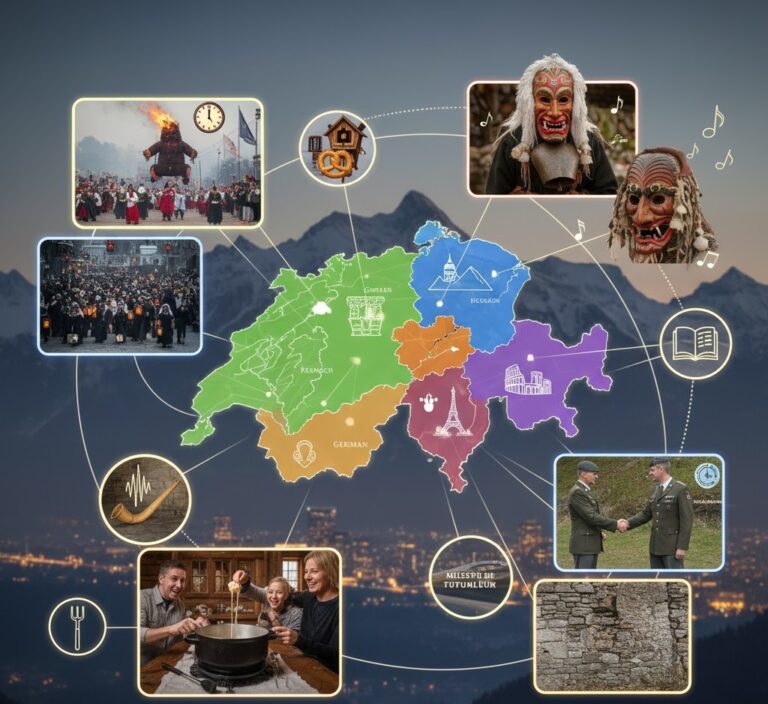
The political and cultural dividing lines in Switzerland are named after food. The border between the German and French-speaking regions is known as the Röstigraben (meaning “Rösti Trench” or “Potato Fry Trench”). The Italian-speaking region of Ticino is separated by the Polentagraben (“Polenta Trench”). These lines symbolize different political behaviours, even in matters like national referendums.
The Militia Principle (Milizsystem) serves as a fundamental cultural code that strengthens high trust in political institutions and social cohesion by requiring citizens to actively participate in administration and public duties.
Fact 6: Breaking the Rules Can Break Your Fork
Switzerland’s commitment to rules infiltrates even the most intimate settings. During the fondue ritual, dropping your bread into the pot is the greatest “crime.” This situation is a social game that brings penalties for the offender, such as having to eat garlic (Garlic Gauntlet) or dancing with the person next to them (Fondue Dance-Off). This shows the Swiss society’s desire to maintain social order and group interaction even at a micro-level.
Workplace Communication: Punctuality and diligence are expected in Swiss work culture. It is critical for new immigrants to show patience in understanding the Swiss communication style—which is more indirect than German/Austrian—as well as the norms for feedback and expectations for openness to innovation.
Final Conclusion
Living and working in Switzerland promises a high quality of life, excellent public services, and a strong economic future. However, this success lies not just in receiving a high salary offer, but in meticulous financial planning, absolute compliance with legal procedures, and deciphering Switzerland’s subtle social codes. Pack your bags, take your salary calculator, and remember: The key to success in Switzerland is Financial Planning, Legal Patience, and Fork Discipline.