SWITZERLAND’S CULTURAL CODES: MYSTERIOUS RITUALS AND THE ART OF LIVING
The Quadrilingual Structure and Local Traditions
Beyond its economic and political stability, Switzerland is defined by its ability to meticulously maintain local traditions within a complex federal structure where four different languages coexist. This multilingual structure is expressed through unique cultural codes that extend far beyond geographical boundaries.
Based on my observations, the two most distinct features of Swiss culture are responsibility and respect. It’s incredible to me that people who live so closely intertwined with nature have formalized their respect for nature into a cultural tradition and responsibility. Furthermore, we must address some unspoken cultural codes. This is a society made up of people who are remarkably similar to one another. We see a population that is very similar both in terms of lifestyle and behavioral patterns. The fact that even integrated immigrants establish a way of life that closely resembles that of the Swiss makes me think about how effective the education system is. If you’re curious about the details of this system and its impact on career paths, I recommend reading our article: The Swiss Education System.
Linguistic Borders and Preserved Identities
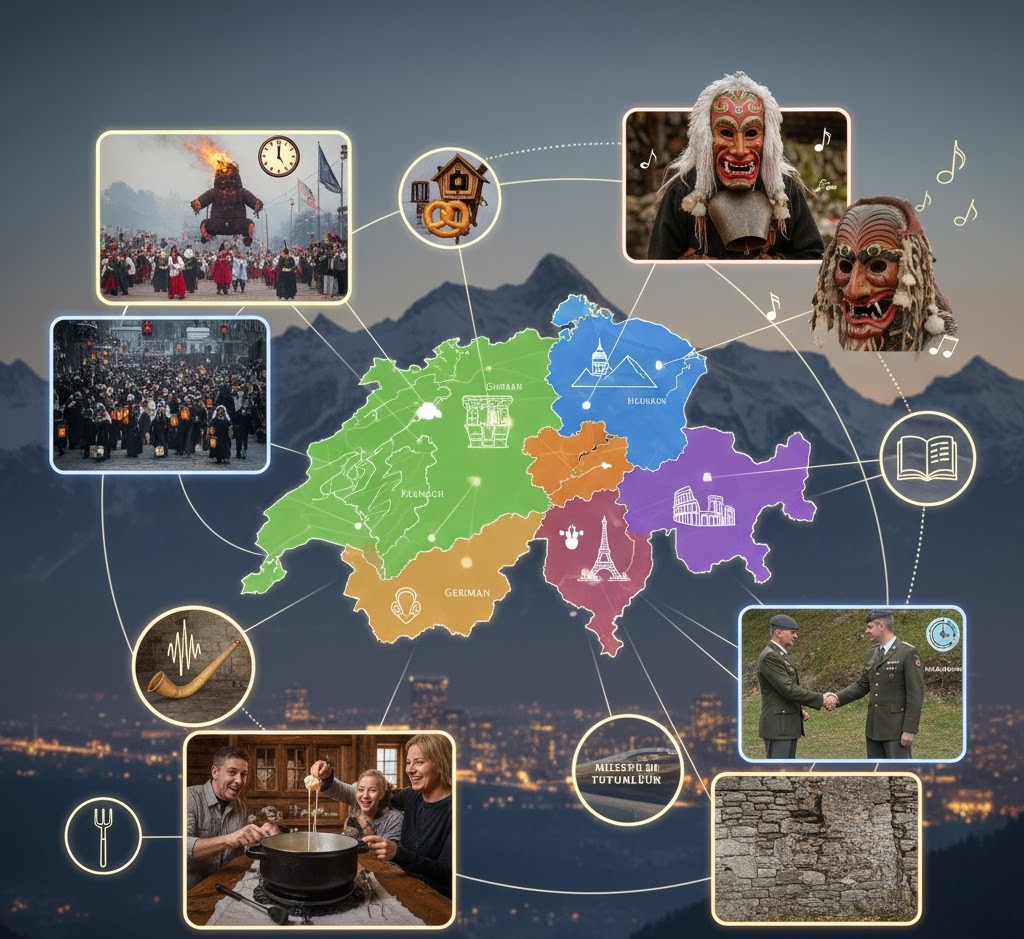
Röstigraben and Polentagraben: The cultural and political boundary between the German-speaking and French-speaking regions is called the Röstigraben (literally “the Rösti Trench”). This term functions as a powerful metaphor to define differences in national voting and socio-economic behaviors. Similarly, the Polentagraben expresses the cultural differences between the Canton of Ticino (Italian-speaking) and the rest of the country.
The Romansh Art of Survival (Graubünden): Although Romansh is the smallest national language of Switzerland (only 0.5% of the population), it has been granted official language status at the federal level since 1996. The Canton of Graubünden pursues a cultural survival strategy by meticulously preserving the language and local styles.
Ticino’s Patience Ritual (Polenta): In Italian-speaking Ticino, traditional polenta must be cooked over low heat for about two hours. This dish, still served in local restaurants (grottoes), is a strong expression of the region’s unique cultural rhythm, standing in contrast to the efficiency-focused pace of Northern Switzerland.
Living and Mysterious Local Traditions
Swiss culture is rich with rituals—some of which are esoteric—that span across cantons and local communities.
Region (Canton) | Tradition/Ritual | Timing and Duration | Status / Primary Function |
|---|---|---|---|
Zurich | Sechseläuten | First Monday after the spring equinox (6:00 PM) | Living: Burning the Böögg snowman, which symbolizes winter. Maintained by traditional guilds. |
Basel | Basler Fasnacht | Starts at 4:00 AM on the Monday after Ash Wednesday, lasting 72 hours. | Living (UNESCO Heritage): The largest Protestant carnival. It serves as a satirical platform for mocking societal flaws. |
Appenzell | Silvesterkläuse | December 31st or Old Year’s Eve (January 13th) | Living: A magical performance where masked figures (the Beautiful and the Ugly) roam the countryside with cowbells, delivering New Year’s wishes. |
Valais | Lötschental Tschäggättä | From Candlemas to Ash Wednesday. | Living (Localized): Carnival figures wearing eerie, hand-carved wooden masks to drive out evil winter spirits. Only celebrated within the valley. |
The Permanence of Traditional Art and Social Codes
Forgotten/Transformed Arts:

Alphorn: This 3 to 4-meter long traditional wooden instrument was historically used by shepherds for communication. Although it has largely lost its original function, it persists today as a musical performance tool at festivals.
Yodeling: It continues to be practiced as an art form, maintained by competitions with strict evaluation criteria.
The Militia Principle and Civic Identity (Structural Code):
- The Militia Principle (Milizsystem) is a cultural characteristic of Swiss democracy. It requires citizens to take active roles in government, the military, and civil positions rather than relying solely on full-time professionals. This is a fundamental social tradition that strengthens trust in political institutions and ensures Switzerland’s stability.
The Fondue Court (Daily Social Ritual):
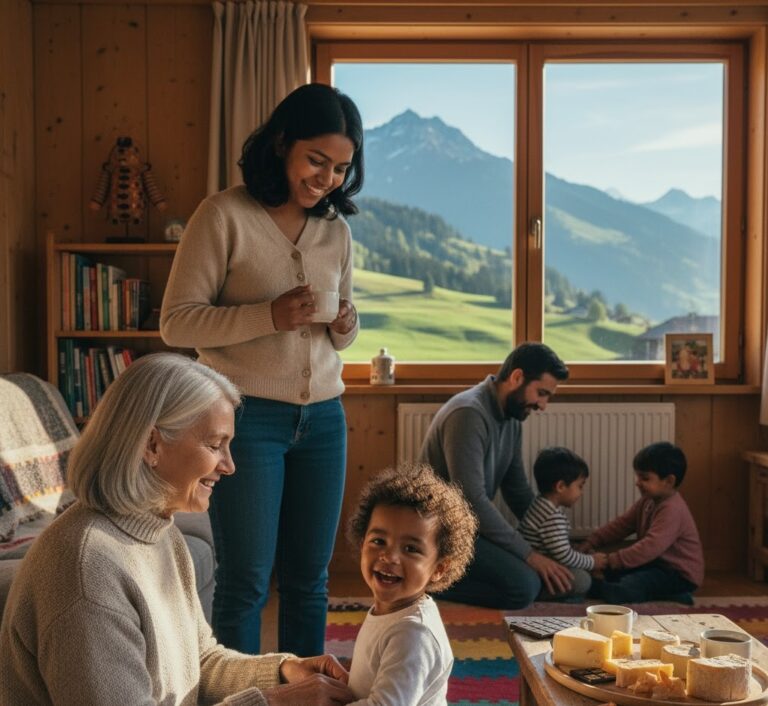
- Fondue is not just a meal in Switzerland, but a social ritual governed by fun, strict rules. Dropping bread into the fondue pot is traditionally considered the greatest “crime,” triggering the “Swiss Fondue Court.” This gamified system of penalties (eating raw garlic, dancing) reflects the widespread tendency in Swiss society to define and enforce rules even in the most casual settings.
Frugality in Material Culture (Hidden Code):
- The reuse of building components (spolia) from ancient buildings in new construction was a common practice until the modern era. This ethic of reuse is a hidden reflection of Switzerland’s structural frugality and resource conservation culture.