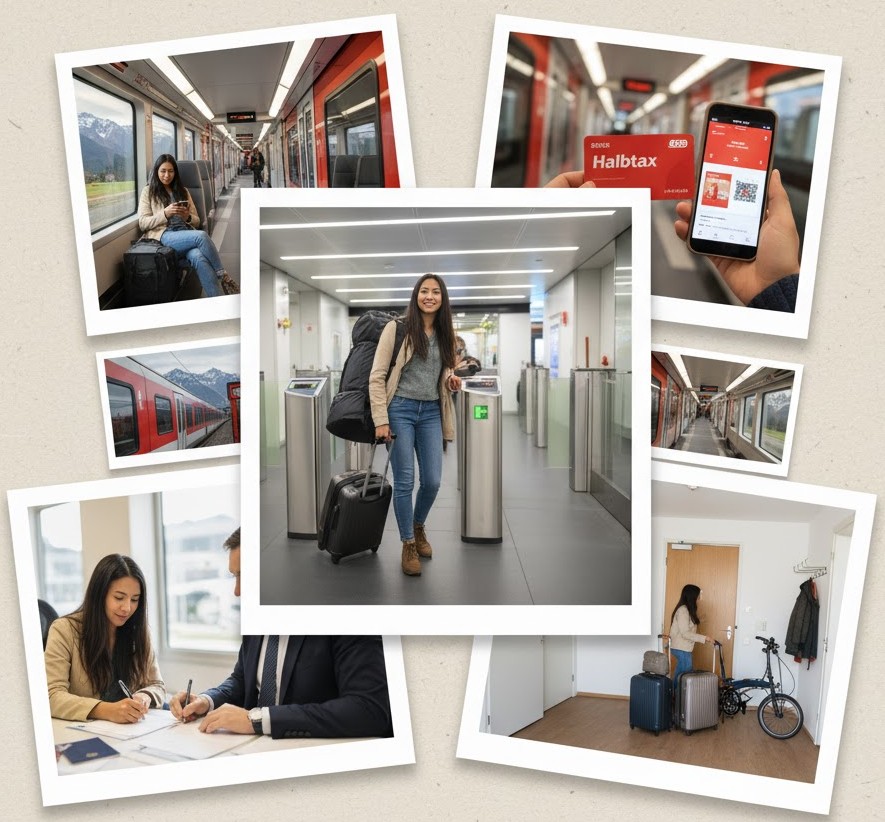
Your First Day in Switzerland: Step-by-Step Critical Guide from Airport to New Home
focusAnalysis: The moment you first step into Switzerland, after struggling with your fear of flying (which I can openly say I experience on every flight) and the crowds at the airport, marks the beginning of a marathon, no matter how prepared you are.
The shock of bureaucracy, the language barrier, and the feeling of uncertainty—trust me, everyone has felt these emotions. A successful settlement is not just about unpacking your luggage, but about registering with the local municipality within 14 days and fulfilling your mandatory insurance obligation within 3 months. This chronological timeline is vital for managing the stress of your first day.
🎯 Core Definition
The immigrant’s first day in Switzerland is the first and most crucial step taken to legalize residency. These initial steps form a collection of careful procedures required both to settle in and to declare to the state, ‘I am here!’
The start is marked by administrative obligations, such as the [I explained the registration details here] (to be completed within 14 days) and mandatory health insurance to be finalized within 3 months.
✅ Essential Information: Kicking Off the Legal Process in Switzerland
Understanding the legal and administrative framework for settling in Switzerland protects you from unexpected traps. By taking the correct steps from day one, you prevent problems common in an immigrant guide.
The Legal Trigger for Residency
All new foreigners are obligated to register in person with the local municipality (Gemeinde/Commune) within 14 days of entering the country. In some regions, like Canton Vaud, this deadline can be as short as 8 days—meaning you have very little time!
This process also initiates your biometric procedures for the [Check this guide for permit types]. The first thing the clerk usually asks during registration is where you live. Make sure you have your tenancy contract ready.
Mandatory Health Insurance Rule
Everyone residing in Switzerland (including international students) is legally obligated to take out mandatory health insurance ([basic insurance details here]).
The legal period granted to new immigrants to finalize this contract is 3 months from the date of arrival. This 3-month window gives you time for the initial shock to pass. There is no need to panic right away.
✅ Detailed Guide: Transitioning from Airport to Life
📌 Border Control and E-Gates: Your Guide to Avoiding Crowds
As non-EU/EFTA citizens, presenting your long-term residence permit documents (D-visa, etc.) at border control is mandatory. Ensure your passport is not expired.
Especially for those who dislike airports and crowded places, the automated passport gates (E-Gates) found at major airports like Zurich offer great relief. B/C permit holders with biometric passports can use these gates, helping you avoid long waits in manual queues.
For more information on border control and passport procedures, you can visit the Federal Customs and Border Security Office (FOCBS) website.
📦 Personal Goods and Household Effects Import (Form 18.44)
The most crucial step for duty-free moving is submitting the originally signed Form 18.44 (Household Effects) to customs. Don’t make the mistake I made: you must prove that the goods you bring are older than six months. New electronics are not covered.
You must attach supplementary documents such as your tenancy contract or work contract to prove the transfer of domicile. Find official information on duty exemption conditions here.
You can reduce your waiting time at the border by utilizing the Preliminary Examination option at commercial customs offices.
🚦 Day One Communication: The SIM Card Strategy
It is vital to obtain a SIM card before you open a local bank account or receive your B permit. On my first day, I opted for an MVNO (Mobile Virtual Network Operator) such as M-Budget or Yallo.
These providers allow you to quickly establish the necessary communication link for administrative procedures. You can easily communicate with these providers until your bank account is opened.
💰 Transport Costs: You Must Buy the Half-Fare Card Immediately
Once you gain legal residency status, the specialized tourist Swiss Half Fare Card is no longer suitable for you, and knowing this prevents financial loss. The standard solution for Swiss residents is to immediately purchase the [Check this guide on public transport].
If you don’t do this, you will unnecessarily lose double the money; I experienced this myself in my first year! The card pays for itself after just four return trips between Zurich and Bern. Identity verification is mandatory for the subscription, and a temporary SwissPass can be issued immediately.
✅ focusAnalysis: The Hidden Trap of Your First Home and the Handover Protocol
When I lived in Bern, I signed the handover protocol (Wohnungsabnahmeprotokoll). No matter how tired you are, be careful when signing this document. Because signing it, I later learned, means taking responsibility for all defects not listed in the protocol.
The most important shield the Swiss tenancy law offers the tenant is the right to report defects missed during the handover—the [tenant rights details here] (Mängelrüge). Use this right! Otherwise, you could be forced to cover the cost of the expensive detailed cleaning and damage repair when you move out.
Step 1: Leaving the Airport and Initial Transport
Use the SBB app for transport from the airport. To avoid high exchange fees, when withdrawing cash from any ATM, always select CHF as the currency. Obtain an MVNO SIM card on your first day to set up your communication line.
✅ Cost / Deadline Table
Administrative Step | Legal Deadline | Average Cost | Importance Level |
|---|---|---|---|
Municipality Registration | 8-14 Days after Arrival | CHF 15 – 30 | High (Legal Start) |
Mandatory Health Insurance | 3 Months (90 Days) after Arrival | Varies by Canton | High (Legal Obligation) |
Half-Fare Travelcard | First Month (Recommended) | CHF 120 – 190 (Annual) | Medium/High (Cost Optimization) |
Reporting Defects (Mängelrüge) | 10-30 Days after Moving In | CHF 0 | Medium (Financial Protection) |
FAQ
- Q: What if I don’t speak the language of the region I live in when registering with the municipality (Anmeldung)?
- > Answer: Official authorities are not obliged to provide you with a translator. If you live in a German-speaking canton, learn the key administrative terms (Gemeinde, Migrationsamt, Krankenversicherung) or bring a supporter with you. Learn these three words to ease the shock of the language barrier.
- Q: What happens if I miss the 3-month deadline for mandatory health insurance (Grundversicherung)?
- > Answer: The canton will forcibly assign you to a company. Worst of all, your contract will be backdated to your entry date (retroactive payment obligation). This will cost you much more. Therefore, definitely do not miss the 3-month deadline.
- Q: Which currency should I select when withdrawing cash at the airport ATM?
- > Answer: To avoid high international transaction fees, always select the transaction in Swiss Francs (CHF). Using your own bank’s exchange rate helps you avoid the poor local conversion rate (DCC) offered by the ATM provider.
✅ Alternatives
- Financial Alternative: The process of opening a traditional bank account can be lengthy due to documentation. For the first few weeks, you can temporarily use local PostFinance (the Post Office’s banking service) or international digital banking solutions (e.g., Revolut, Wise) to avoid high international transaction fees.
- Transport Alternative: Although the SBB’s GA Travelcard (General Subscription) is costly (CHF 2,780+ annually), it offers unlimited travel across the entire Swiss public transport network, which is a good alternative if you commute long distances two or three times a week.
✅ Recommendations / Tips
- Instantly Learn Neighborly Law and Quiet Hours (Ruhezeiten): Adhering to neighborly law and Ruhezeiten (especially the noise ban on Sundays) affects your social integration faster than legal procedures.
- Respect the Laundry Schedule (Rota): Violating the rotation system in shared laundries is seen as a serious social transgression in Switzerland and strains neighborly relations.
- Adopt the Discipline of Waste Separation: Waste management and recycling are fundamental cultural obligations. Note that local authorities may open discarded garbage bags to check for rule violations.
✅ Conclusion and Call to Action
Your first day moving to Switzerland starts a critical adaptation process that demands planning and respect for bureaucracy, but the reward is a peaceful and orderly life. The fastest strategy is to accelerate your legal process by completing the Municipality Registration (Anmeldung) in the first week, and then optimizing your costs by researching the Half-Fare Card and Health Insurance. By following these steps chronologically, you will successfully complete the first and toughest stage of your Swiss settlement.
Remember, you are not alone in this process. We all went down this road. If you found this guide useful, please share it on social media to help other immigrants ease their process. Share in the comments what bureaucratic step surprised you the most upon your arrival in Switzerland!