My First Month in Switzerland: The 7 Biggest Hurdles and How I Overcame Them
focusAnalysis: The Shock of the First Month and Starting a New Life
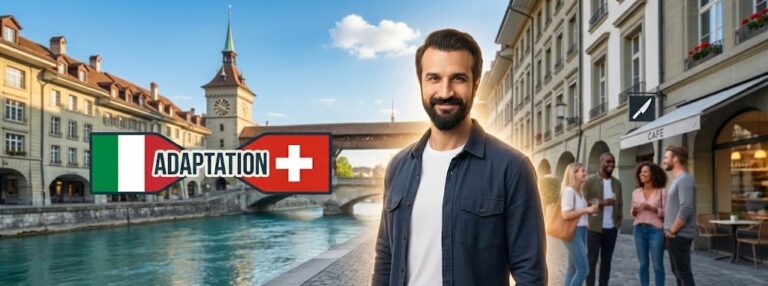
Dear fellow traveler, I know exactly how confusing and exhausting the first steps in this country can be. My first month in Switzerland went very differently than I had anticipated. The system, which looks like it works perfectly from the outside, can turn into a labyrinth of complex, rigid, and impersonal bureaucracy when you enter it. As someone who came to Switzerland through marriage in 2015, I remember the initial confusion and difficulties I faced in great detail. Regardless of your reason for immigration (work, family reunification, education), that initial adjustment process is draining, both mentally and financially. My goal is to share my experience and the obstacles I overcame, helping you navigate this process more consciously and with less stress. Remember, you are not alone on this journey.
✅ Purpose of Arrival and The Shock of the First Impression
My reason for coming to Switzerland was deeply personal: marriage. When I arrived in Bern in 2015, I thought I would have a soft landing thanks to my spouse’s family and the local environment. Instead, the reality hit me hard when the first official presented me with the documents.
My initial impression was of flawless order, incredible punctuality, and a logical explanation for everything. But this perfection also meant a high barrier. Although I had learned Italian while living in Italy, the obligation to demonstrate German language skills in Canton Bern was the first major surprise.
The Emotional Shock: The first shock I experienced upon arrival was seeing that everyone around me was navigating things much more easily than I was. It was as if everyone knew the invisible rules of this country, and I was the outsider. A bus delay, a missing bank form, or not understanding a German conversation… I had the potential to violate a small rule at any moment, and this created constant stress. Without my wife’s support, just wrestling with the official paperwork alone could have brought me to the point of turning back in the first week. This process taught me that surviving in Switzerland is not just about finding a job, but also about correctly deciphering the legal and administrative rules.
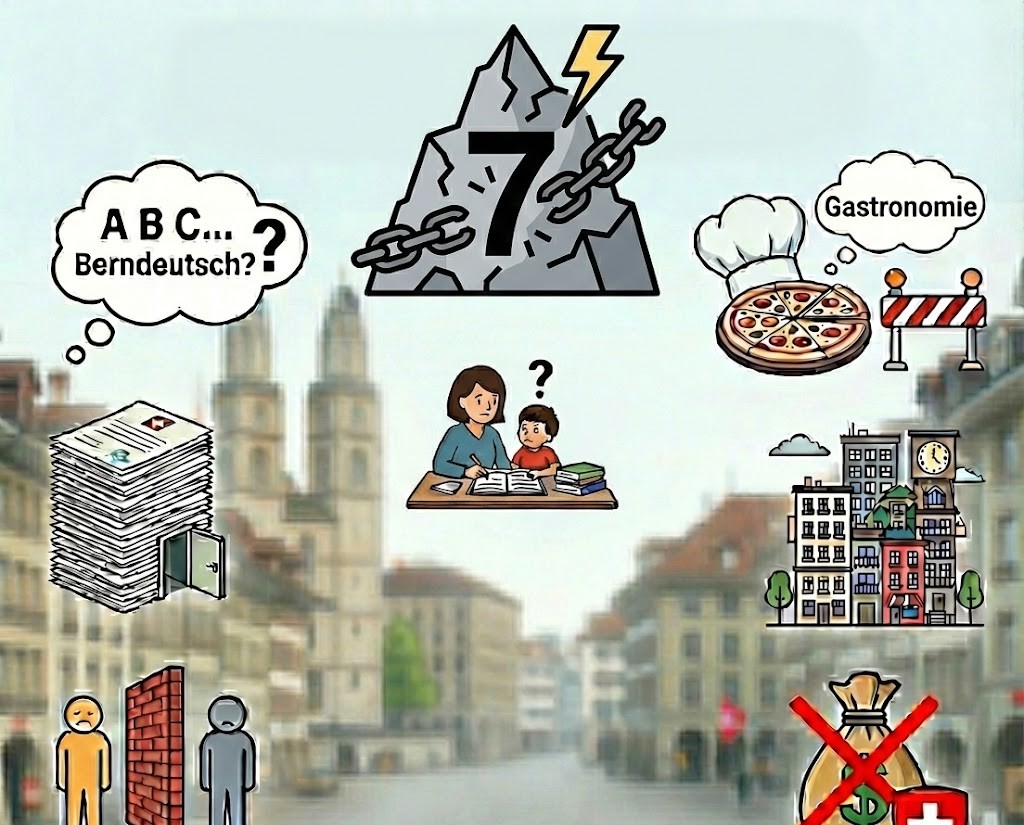
✅ The 7 Critical Areas of Difficulty in the First Month
The structural challenges I faced during the first 30 days that most slowed down my adaptation are listed below. Each of these challenges created its own battlefield:
🗣️ The Language Deadlock: The Chasm Between Dialect and High German
Language was my first and biggest disappointment in Switzerland. Since I had learned Italian while living in Italy, I thought having one of the four official languages would be an advantage. However, when I came to Bern, facing the obligation to demonstrate German proficiency in Canton Bern was the first slap. The real difficulty emerged when I started the German course: there was an incredible chasm between the fluent, rule-based High German (Hochdeutsch) taught in the course and the local Berndeutsch dialect I heard on the street, in the market, or even spoken between my spouse and her family.
These two felt like two completely different languages at times. The polite and clear sentences I learned in class remained a language hardly anyone used in practice. I had incredible difficulty understanding the speed, pronunciation, and vocabulary of the local dialect. As a Chef/Pizzaiolo in a restaurant, sometimes having to ask a customer what they wanted repeatedly because I couldn’t understand them, even damaged my professional self-confidence. I experienced this not just as language learning, but as overcoming a cultural barrier to be accepted. The feeling of being culturally excluded was ever-present.
🚦 Excessive Bureaucratic Hurdles
The Swiss discipline of doing everything by the book eventually turns into an exhausting chore. Although the system works flawlessly, the price of this order is excessive bureaucracy and endless forms. In the first month, I panicked at the stack of documents I had to fill out for basic procedures like residence permit, health insurance, and opening a bank account. The flexibility we were accustomed to in Turkey or Italy did not exist here: the luxury of making a mistake even on the smallest piece of paper was nonexistent, creating enormous pressure.
The biggest bureaucratic shock concerned my visa. Even though I immigrated through marriage, my documents had to be processed through the Italian Consulate in Milan. This absurd logistical situation added weeks of unnecessary waiting to my already stressful adaptation process. Unbelievable, but true: I was living in a Swiss canton but waiting for my visa from an authority in Italy. This process was not just a waste of time, but stolen moments from a person’s life that cannot be replaced. While trying to integrate into a foreign country, getting caught up in the inter-cantonal and international bureaucratic wheels of the country itself is soul-crushing.
😔 Cultural Isolation and Communication Walls
As someone who comes from the warmth of Mediterranean culture, the social distance in Switzerland genuinely challenged me. One of the natural difficulties I faced in my first month was communicating with people and confronting a different culture. Swiss culture can appear distant and closed, especially initially. Although I worked in a restaurant (as a Chef/Pizzaiolo), my social circle outside of work was quite limited.
Even neighborhood relationships were more distant than expected. Expecting more than a “Grüezi” was difficult. Dealing with a closed culture, particularly due to the language barrier, was very hard. It took time to adjust to this social structure based on formality and punctuality. The intense feeling of loneliness finds you, no matter how big the city you are in. Your only comfort is your family. As we detailed in our article Social Life in Switzerland: Neighborhoods, Festivals, and Leisure Activities, overcoming this feeling of isolation depends entirely on personal effort and patience.
💰 Health Insurance: Obligation and High-Cost Pressure
This was not just an expense item for me, but a symbol of a system I felt was unjust. One of the first things you must do in Switzerland is take out mandatory health insurance. The fundamental problem with the system is that the monthly premiums (Krankenkasse) are astronomically high, and you are forced to pay this amount as a fixed expense, even if you do not get sick, go to the hospital, or use a doctor.
This is a huge slice cut from the monthly budget for working class people struggling against the high cost of living, making saving almost impossible. The feeling of enriching private insurance companies with the money deducted from me is the biggest ethical crack in the system. This cost is an unacceptable burden, especially for those working in low-income sectors (like me), and greatly increases financial stress.
🏠 Housing Crisis: Time and Budget Pressure of the House Search Process
I had heard that the housing market was difficult before coming to Switzerland, but I did not expect this much. The house-finding process was like a professional job application. In your first month, having the right timing or even setting aside a good budget is not enough; you need to have the right profile.
I will never forget the scene: when you go to view an apartment you like, you encounter a long queue of people (Schlange) waiting outside the door. Everyone is dressed in their best clothes, holding their flawless dossiers (salary slips, debt certificates, references). Applications are meticulously scrutinized, as if it were a job application. You have to fit the ideal tenant profile for the landlord. Despite high rents, finding and renting the desired apartment is very challenging. As we stated in our article Guide to Renting a House in Switzerland: Contract, Deposit, and Finding Tactics, this process resembles a race, and finding someone who will rent to you is like winning the lottery.
🔪 Job Field Restriction: No Diploma and Trapped in the Gastronomy Sector
For a person like me who does not possess a Swiss diploma and whose work experience is limited to only one sector (gastronomy – Chef/Pizzaiolo), the job market is quite narrow. Experience and expertise are very important in Switzerland, and the lack of my diploma constantly kept me trapped in the gastronomy sector.
Although I could easily find work in restaurants or hotels (which is my area of expertise), my access to better-paid jobs or different sectors was restricted. Reaching the high-paying jobs in the lists of High-Demand Occupations is contingent on having a good diploma and advanced German/French language skills. Initially, as we detailed in the article Working in Switzerland: Work Permits, Salaries, and High-Demand Occupations, jobs offering minimum wages or those that did not require a formal qualification were the only realistic option. In my first month, I found myself in the vicious cycle of “You have experience, but you don’t have Swiss experience.”
📚 Child Education Balance: The Difficulty of Parental Academic Support
This was the area that challenged me the most personally, as it was directly related to my children’s future. Since I did not receive my education in Switzerland and my German level was not academic, I struggled to give my children full support in their school lives and internal balance.
Especially in the first months, checking German homework, understanding long school letters, and following the academic language used by the teacher in parent meetings was very difficult. Their adaptation to the new system and their struggle with the language barrier increased the pressure on me as a parent. To be able to guide them, I had to learn German quickly and grasp the intricacies of the Swiss education system. This was an obligatory process and an ongoing balancing act that combines parenting and language learning.
✅ What I Learned During This Process (10 Life Lessons)
The difficulties of my first month gave me priceless lessons for my new life. Here is the 10-point summary:
- See Bureaucracy as a Game: Accept official documents not as a chore, but as a mission that must be completed without error.
- Accept the Two Faces of Language: Focus on understanding the local dialect (Berndeutsch) alongside High German, never feel ashamed.
- Control Your Reaction to Injustice: Even if you are angry about the cost of the health insurance system, do not neglect the legal obligation.
- Start the Housing Hunt Early: Begin the house search at least 3 months before arriving and keep all your documents ready.
- Evaluate Your Experience: Even without a diploma, maximize your experience in your single sector of expertise.
- Explore Small Towns: Visit small cantons or towns to escape the chaos and high cost of big cities.
- Take the Step to Overcome Loneliness: Join volunteer organizations or meet new people in courses to break social isolation.
- Ease Financial Pressure: Focus on daily saving methods and discount days to manage your expenses.
- Support Your Children: Join local parent groups to understand your children’s school curriculum.
- Patience is Your Master Key: Adaptation is a marathon; do not let the difficulties of the first month discourage you, keep going.
✅ Photo Gallery
✅ Conclusion
The difficulties of the first month showed me the realities behind the flawless-looking facade of Switzerland. I struggled with many hurdles, from language barriers to bureaucracy and high costs. However, overcoming these obstacles made me stronger and better equipped. This article is a roadmap for every immigrant starting a new life.
You can inspire other newcomers by sharing your experience in Switzerland in the comments!
❓ FAQ (Frequently Asked Questions)
Question: In which three areas do newcomers to Switzerland experience the most difficulty?
Answer: The three areas where new immigrants struggle most are: 1) The Language Barrier (the difference between dialect and High German/French), 2) The Housing Crisis (difficulty finding a home due to high demand and rents), and 3) Mandatory Health Insurance (fixed, high costs that strain the budget even without going to the hospital).
Question: How does the job market and career path change for someone without a diploma in Switzerland?
Answer: The job market for those without a diploma or with limited experience is narrower, often leading to sectors with salaries close to the minimum wage, such such as gastronomy, cleaning, and construction. The career path is only possible by obtaining local language certificates and specializing in the existing sector.
Question: What is the most effective way to deal with Swiss bureaucracy?
Answer: The most effective way to deal with bureaucratic processes is to work with the zero-error principle, meticulously check every document, and be well aware of the jurisdiction of the cantons. Never leave documents until the last minute and always keep a copy.