SWISS HISTORICAL ARCHITECTURE: FROM THE MIDDLE AGES TO THE MODERN ERA
focusAnalysis: Regional Identity and Pragmatism in Architecture
Swiss architecture is an integral reflection of the country’s geographical location and the complex cultural identity formed by its four official languages (German, French, Italian, and Romansh). This is indeed one of the things I am most curious about. There are centuries-old churches, castles, houses, and buildings here; the more I research, the more I remain in admiration. Switzerland has a unique historical structure, and this is reflected in all its architecture. I will address all of them, and as I research, photographs will also be coming. For now, I need to share what I’ve learned and observed. The day will come when I will take my camera and detail every tiny detail in its streets.
Spanning a wide range from the challenging topography of the Alps to the more temperate valleys of the Central Plateau, architectural styles have exhibited strong regional diversity rather than uniform development. This diversity gave rise to the principle of combining the functionality (Funktionalität) underlying the architecture with aesthetic appeal (ästhetischer Reiz).
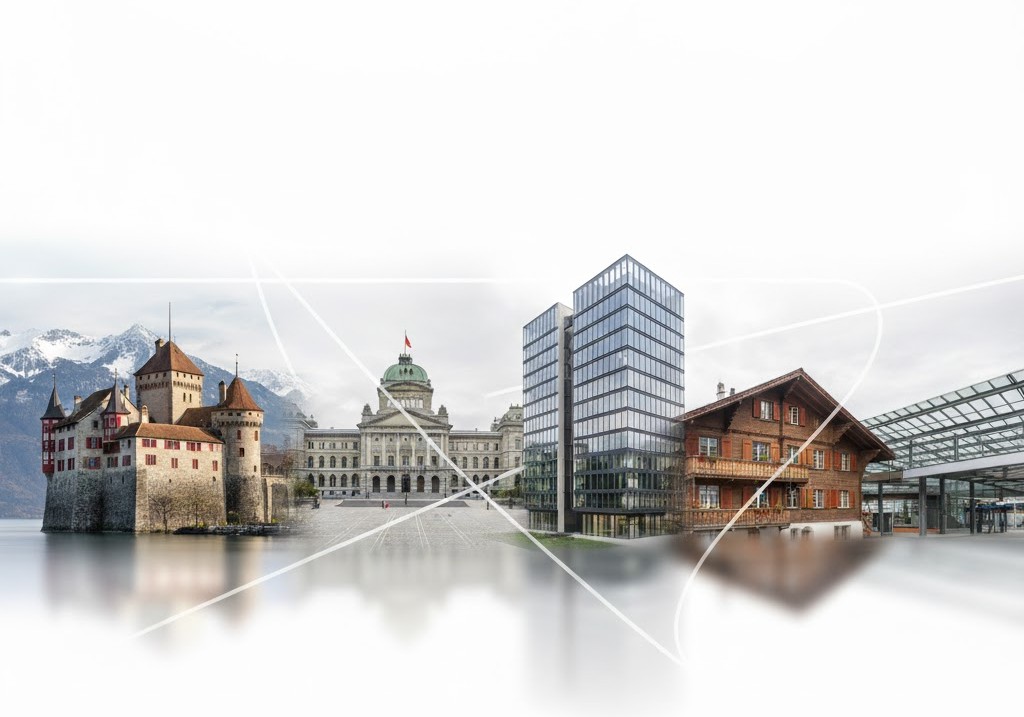
Geographical conditions directly determined the building materials and forms. In the high Alpine regions, sturdy wooden buildings (chalets) with steep roofs were developed to withstand heavy snow and cold climate conditions. In contrast, stone and stucco buildings became widespread in more temperate regions like the Ticino valleys near Italy. This structural variety has been shaped throughout history by macro-historical interactions such as Roman settlement, medieval castle constructions, and the Industrial Revolution. The strength of Swiss architecture stems from its ability to successfully adapt cultural and stylistic elements borrowed from neighboring countries (France, Italy, Germany) to local material constraints and geographical necessities. This adaptation reinforced cultural autonomy, supported by political federalism, and ensured that regionalism remained a dominant architectural theme even in the Modern Era.
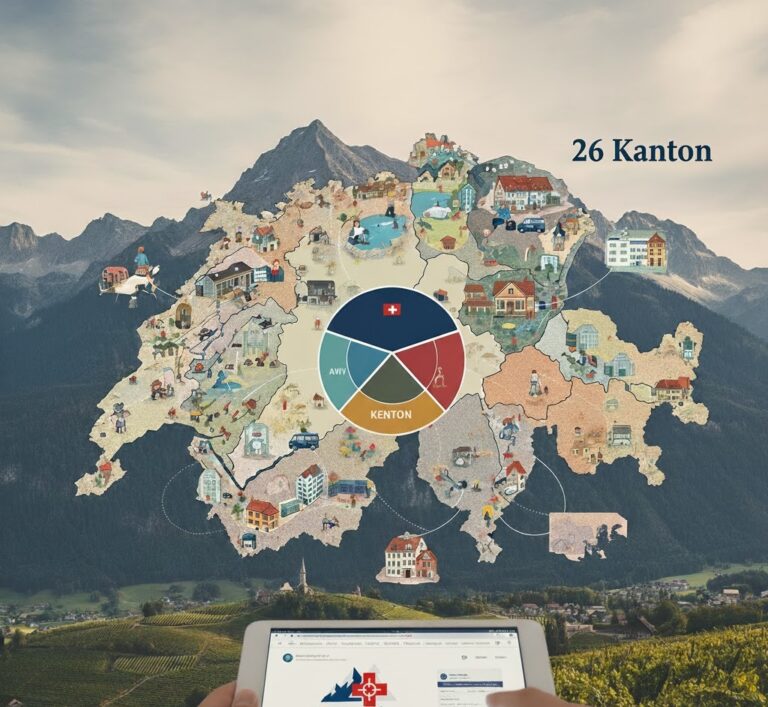
- Federalism and Regional Autonomy: The adaptation of architecture to local realities is supported by political federalism. For a deeper understanding of this complex administrative structure, please read our article: [The 26 Swiss Cantons: Guide to Administration, Population, and Languages].
Medieval Architecture: Faith and Defense
During the Middle Ages, religious structures and defensive architecture in the Swiss territories were central buildings representing spiritual and political power. Just like in all other European countries, this place was heavily influenced by religious themes; this influence is clearly reflected in its architecture. A glance at a cathedral is enough to see this effect. Castle constructions embodied the power of feudal lords, but churches and monasteries stood out as centers of social life and art. Things are not quite like this nowadays, of course. To be honest, instead of being consumed by the lust for money, I would continue the aesthetics and spirit of the old architecture. Styles such as Gothic, Romanesque, and Baroque were implemented with regional interpretations, and each canton shaped its own architectural identity through this religious heritage..
- Pinnacle of Gothic Architecture: Analysis of Lausanne Cathedral Construction of Lausanne Cathedral began in 1170 and lasted about 70 years. The structure’s political and spiritual significance was confirmed at its consecration ceremony in 1275, attended by the highest authorities of the time, Pope Gregory X and Emperor Rudolf I of Habsburg. However, the Cathedral served not only as an architectural monument but also as a physical record of major ideological transformations in Swiss history. The imposition of the Protestant Reformation in 1536 by Bernese troops led to significant architectural and symbolic changes, with relics, altars, statues, and frescoes being removed due to the Reform’s principle of simplification.
- Military and Defense Architecture: Among the most important surviving defense structures from the Middle Ages are the Three Castles of Bellinzona, which represent the strategic control over the Alpine passes and are included in the UNESCO World Heritage List.
Early Modern Era and Urban Identity: Baroque and Rococo
The 17th and 18th centuries marked a critical period when the architectural focus shifted from churches and castles to civil structures reflecting the economic power of the bourgeoisie. The power of money began to determine the form of buildings, instead of the power of God. With the development of trade and industry, the ostentatious residences of wealthy merchants and cantonal administrators, town halls, and guild houses became the new symbols of city centers. This civil architecture, while reflecting the more modest and functional Swiss interpretations of the Baroque and Rococo styles, also highlights how economic power exerted pressure on architecture.
- Monuments of Civic Power: Guild Houses: The Zunfthaus zur Meisen (Meisen Guild House) in Zurich, built in 1757 in the style of a Baroque city palace, is a concrete example of this economic splendor. The relative simplicity of the exterior contrasting with the immense luxury of the interior reflects the controlled wealth philosophy of the Swiss bourgeoisie.
Regional Architectural Language and Vernacular Typologies
- Geographical Determination and Material Adaptation: Switzerland’s challenging geography led to the differentiation of architecture across its four main linguistic regions. This diversity necessitated adapting traditional materials and construction techniques to the local climate.
- The Chalet: From Vernacular Structure to National Stereotype: Although the Chalet is now one of Switzerland’s most recognizable architectural forms, historically, only a small portion of the population lived in these traditional wooden structures. The Chalet became a marketable national myth—a romantic image of a healthy, pastoral lifestyle—amplified by tourism and novels like Heidi.
- Graubünden and Sgraffito Facade Art: The Graubünden (Engadin) region is known for Sgraffito, a traditional facade decoration technique created by scratching patterns onto wet plaster. This art form, which also served as a social communication tool to display family culture and moral standing, is currently being modernized through digital portals using augmented reality (AR) technology.
The Late 19th Century and Transition to Modernism
- Historicism and the Search for National Identity: Swiss architecture at the end of the 19th century was influenced by Historicism. The Swiss National Museum in Zurich (Gustav Gull, 1898), with its picturesque grouping inspired by medieval architecture, is a typical example of this approach.
- Karl Moser: The Bridge Figure: Architect Karl Moser served as a critical bridge figure in the architectural development of the 20th century in Switzerland. As a pioneer from Art Nouveau (Jugendstil) to Modernism, his work provided the key for Switzerland to adopt the International Style as a national language.
The Paradoxical Role of Switzerland in the Modern Movement
- Le Corbusier and the Installation of Functionalism: Charles-Édouard Jeanneret (Le Corbusier), the Swiss-born pioneer of modern architecture, spent the majority of his career in France because his radical concepts were difficult to accept in Switzerland. This situation—the country pushing its greatest architectural genius abroad—proves the strong local resistance to abstract Functionalism. (17 of Le Corbusier’s projects across 7 countries are included in the UNESCO World Heritage List in 2016).
- Post-Modernism and the Aldo Rossi Effect: After the 1960s, the influence of Italian architect Aldo Rossi at ETH Zurich played a significant role in freeing German-Swiss architecture from the rigid functionalism of the Second Modern Movement.
New Regionalism and Heritage Management
- Ticino Tendenza (Regional Traditionalism): This movement, prominent in the 1980s and led by figures like Mario Botta, successfully blended the abstract rationalism of Modernism with local materials (stone) and traditional forms, demonstrating a poetic approach to structure.
- Basel: Center for Architectural Innovation: Basel, often called the “architecture capital of Switzerland,” is home to Pritzker Prize winners like Herzog & de Meuron. It focuses on sustainable construction strategies and Adaptive Reuse (converting historic structures for contemporary needs).
Conclusion
Swiss architecture possesses a dynamic historical trajectory, beginning with the religious and defensive structures of the Middle Ages, evolving with the Guild Houses reflecting the economic power of the bourgeoisie, and giving birth to the radical modernism of Le Corbusier while grounding it in local context. The architectural excellence of the country lies in its ability to transform the necessities brought by geographical and cultural diversity into an artistic advantage, all while maintaining the highest standards of aesthetics and craftsmanship. You can find more about how this cultural and historical depth influences the general fabric of life in Switzerland in our Switzerland: The Ultimate Guide article.