Swiss Canton Jurisdiction: The Federal Test Between 26 Cantons
focusAnaliz: The Secret of Harmony and the Will to Live Together: Switzerland’s Greatest Test
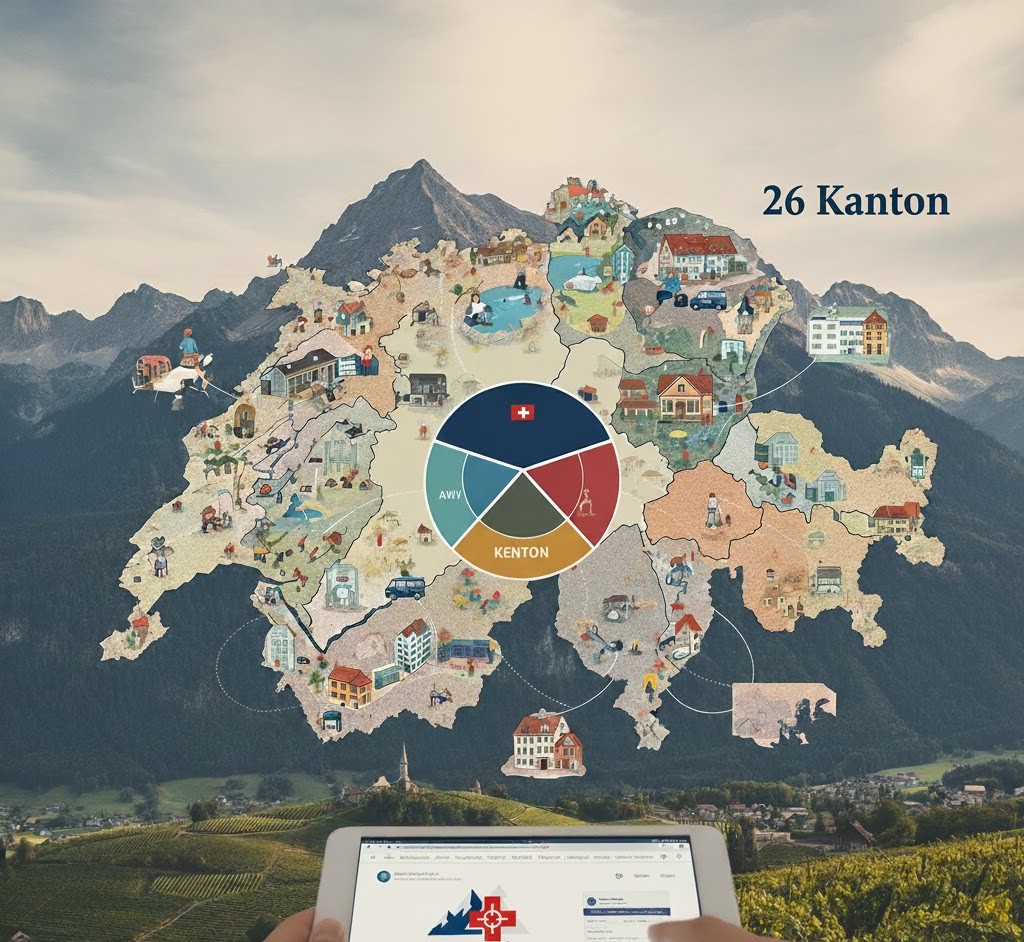
Eating Zungenwurst for lunch in Bern, while people 100 kilometers away in Geneva dream of Crêpes for dinner; or filling out a German form in Zurich while being answered in Italian in Ticino… Switzerland is precisely a mosaic full of these small, charming contradictions. This country, contrary to popular belief, is not a structure governed from a single center, but a federal system, built upon 26 autonomous regions, rarely paralleled anywhere in the world. Switzerland’s true strength comes from the ability of each canton to set its own rules.
This article delves into Switzerland’s political and geographical DNA; it explains how powers are distributed and how this geographical structure shapes daily life. However, this situation, for an immigrant, also means a significant learning curve and bureaucratic difficulty in areas like taxes, residence permit extensions, and even child allowances. You can find all the essential information on this complex structure in our article Switzerland: The Ultimate Guide.
✅ Quick Summary Table:
Aspect | Description | Level of Authority |
|---|---|---|
Governance Model | Three-tiered Federalism (Confederation, Canton, Commune). | All three levels. |
Primary Authority | Legislative power belongs to the cantons in all areas not explicitly regulated by the Federal Constitution. | Cantons. |
Major Discrepancies | Education system, police forces, healthcare system, and taxes vary widely from canton to canton. | Cantons. |
Historical Basis | The system was established with the Federal Constitution of 1848, based on the principle of equality among peoples. | Federal Level. |
Immigrant Impact | Tax inequality and bureaucratic complexity in residency procedures. | Cantons. |
🎯 Main Definition:
The Swiss Cantonal System is one of the world’s most stable and complex governance structures, where powers are constitutionally shared between the central Confederation, 26 semi-autonomous cantons, and local Communes (Municipalities), allowing each canton to set its own laws and determine its own taxation.
✅ Core Information:
The Federalism Triangle: Conflicts of Authority Among the Confederation, Cantons, and Communes
Switzerland’s administrative structure is three-tiered: Confederation (Federal Government), Cantons, and Communes (Municipalities). Contrary to popular belief, the Confederation does not decide everything. The rule is: legislative authority belongs to the cantons in all matters not explicitly regulated by the Federal Constitution. For a detailed map of the country’s geographical and administrative structure, I suggest you review the article The 26 Swiss Cantons: Guide to Administration, Population, and Languages.
Federal Authority (National Issues)
This covers big-picture topics such as foreign policy, national security, monetary policy (the Swiss Franc), customs, and the supervision of the Federal Court. For example, authority lies with the Confederation in the event of war or the signing of international treaties. This ensures the country speaks with one voice externally.
Cantonal Authority (Major Differences)
In my opinion, the real complexity and beauty begin here. Cantons pass their own laws in areas that directly affect the individual’s life, such as the school system (Education), police forces, the healthcare system, and most importantly, taxes. For instance, the school system may be regulated completely differently from one canton to another regarding the number of mandatory language courses for a child.
Commune (Municipal) Authority (The Heart of Local Democracy)
This is the smallest administrative unit, where direct democracy operates at the local level, sometimes even having the power to determine tax rates. The Swiss people often participate directly in making local decisions. Communes undertake services such as street cleaning and the maintenance and renovation of school buildings themselves.
✅ Detailed Guide:
📌 The Political Laboratory: Cantons Operating Like Small States
When I first arrived in Switzerland, everything felt like a labyrinth. A rule in one canton was invalid in the next. This showed us that the cantons in Switzerland operate like small states. However, I believe the true secret that makes Switzerland one of the world’s most stable countries lies in the power of these local governments and the direct role of the public in governance.
- The Historical Consensus: In my view, the Swiss cantonal system is one of the greatest and most beautiful examples of coexistence that many states should emulate. Because Switzerland managed to establish a system in the Federal Constitution of 1848 that emphasizes the equality of all peoples.
💰 Inter-Cantonal Tax Inequality and the Effect on Low Wages
Perhaps the most ruthless and criticized aspect of the cantonal system is the deep inequality in the tax and social welfare systems. This was one of the biggest shocks I encountered as an immigrant.
In my opinion, inter-cantonal competition creates tax havens for corporations while it makes life difficult for low-wage earners. For example, a person with the same income working in the Canton of Zurich is subject to a different amount of withholding tax (Quellensteuer) than a person working in Geneva or Bern, depending on their canton of residence. This situation unfortunately overshadows the Swiss philosophy that emphasizes that no one is superior to another, at least on the economic level. The detailed analysis of these tax differences can be found in our article Swiss Tax System Cantonal Difference Guide.
🚦 Bureaucratic Difficulties for Immigrants
Regarding residence permits, although the Federal Government sets quotas, it is up to the canton how they distribute these quotas internally and how meticulously they handle the processes. This situation means a bureaucratic burden that complicates life for immigrants. Tracking issues like Swiss Residence Permits (B, C, L): Which One is Right for You? becomes especially complex due to the strong cantonal differences.
✅ Experience / Recommendation Section:
focusAnaliz: Is the System the Best in the World?
In my opinion, despite its flaws, this system is currently the best and only system in the world. Its strength lies in the direct role of the people and decentralized power. Nonetheless, the challenges brought by this structure, especially in the first years of integration, create a significant burden.
✅ Step-by-Step Guide / Application:
✅ Step 1: Learn Your Canton of Residence’s Rules
Before or immediately after moving, learn the local tax rates, the amount of child allowances, and the mandatory language course requirements of your canton of residence (e.g., the Zurich Canton Integration Guide or the Bern Canton).
✅ Step 2: Focus on Withholding Tax
Since the income taxes of foreigners without a C permit are deducted directly from their salary (Quellensteuer), calculate the net amount you will receive based on the tax rate of your canton of residence during salary negotiations.
✅ Step 3: Participate in Local Democracy
Follow the meetings and decisions at the Commune (Municipal) level, which can even have a say in taxes. Political participation is an integral part of Swiss life, as detailed in the article Direct Democracy: Why and How the Swiss People Vote on Everything.
✅ Cost / Fee / Duration Table:
Item | Description | Duration / Rate |
|---|---|---|
Cantonal Tax Rate Difference | Net difference between the most expensive (GE/VD) and cheapest (ZG/SZ) cantons. | Up to 20% |
Mandatory Education | Varies as it falls under the cantons’ authority. | 11 Years (Can vary by canton) |
Federal Constitution Adoption | The legal beginning of the cantonal system. | Year 1848 |
✅ Frequently Asked Questions:
S: Can cantons manage the issuance of residence permits completely independently?
Answer: No, the Federal Government sets the general quotas and laws. However, cantons have autonomy over how they distribute these quotas internally and how meticulously they conduct the processes for foreigners.
S: Why does tax inequality persist?
Answer: Because there is tax competition between the cantons. Low tax rates are a tool used to attract capital and high-income individuals to the canton. Therefore, the system can work against low-wage earners.
S: Can cantons close their own borders?
Answer: No. However, cantons have the authority to manage services like police, health, and education within their borders independently under the framework of the Federal Constitution.
✅ Alternatives:
- Joining Political Associations: Instead of direct party membership, join cantonal non-governmental organizations focused on specific issues like tax fairness.
- Inter-Cantonal Relocation Plan: First settle in a canton with relatively affordable rent and taxes, and plan to move to high-cost centers like Zurich or Geneva after improving your financial situation.
✅ Recommendations / Tips:
- Quickly Adapt to Local Swiss Rules: Quickly adapt to local Swiss Rules of Life: Order, Silence, and Adaptation Guide (Quiet hours, garbage separation). This strengthens your relationship with the local population.
- Tax Optimization: Seek tax advice in your canton of residence. Check the tax burden in your new canton before moving.
- Prepare for Bureaucracy: Always keep backup documentation for residence permit extensions and financial matters.
✅ Conclusion:
The Swiss Cantonal System is the rarest and most stable model of coexistence; it decentralizes the power of the people down to the Communes. However, the tax inequality and bureaucratic complexity that this system brings for immigrants is a personal test. Therefore, to build a stable life in Switzerland, you must actively learn the cantonal rules and design your own financial strategy according to these local laws, rather than accepting them as a passive victim.