Direct Democracy: Why and How the Swiss People Vote on Everything

✅ 1) Introduction
Switzerland captures the attention of the world with its high level of prosperity and mountain landscapes. However, what makes the country politically unique is direct democracy at the heart of its political system. Swiss citizens vote directly on everything from pension schemes to new highway tunnels, casting their ballots (mostly by mail) an average of four times a year.
focusAnaliz: The Greatest Example of Coexistence
In my opinion, the Swiss system is one of the greatest and most beautiful examples of coexistence that many states should emulate. Furthermore, thanks to direct democracy, there is no word above the will of the people. Although there are still states today that consider their own race superior, Switzerland managed to keep its peoples together and establish a system where no one places themselves above another. This system emphasizes the equality of all.
✅ 2) Quick Summary Table
Heading | Brief Information |
|---|---|
Basic Definition | Semi-Direct Democracy (Representation + People’s Rights) |
Voting Frequency | Average 4 Times Per Year (By Mail) |
Core Instruments | Popular Initiative and Referendum |
Critical Rule | Double Majority (For Constitutional Issues) |
✅ 3) Basic Information: What is Semi-Direct Democracy?
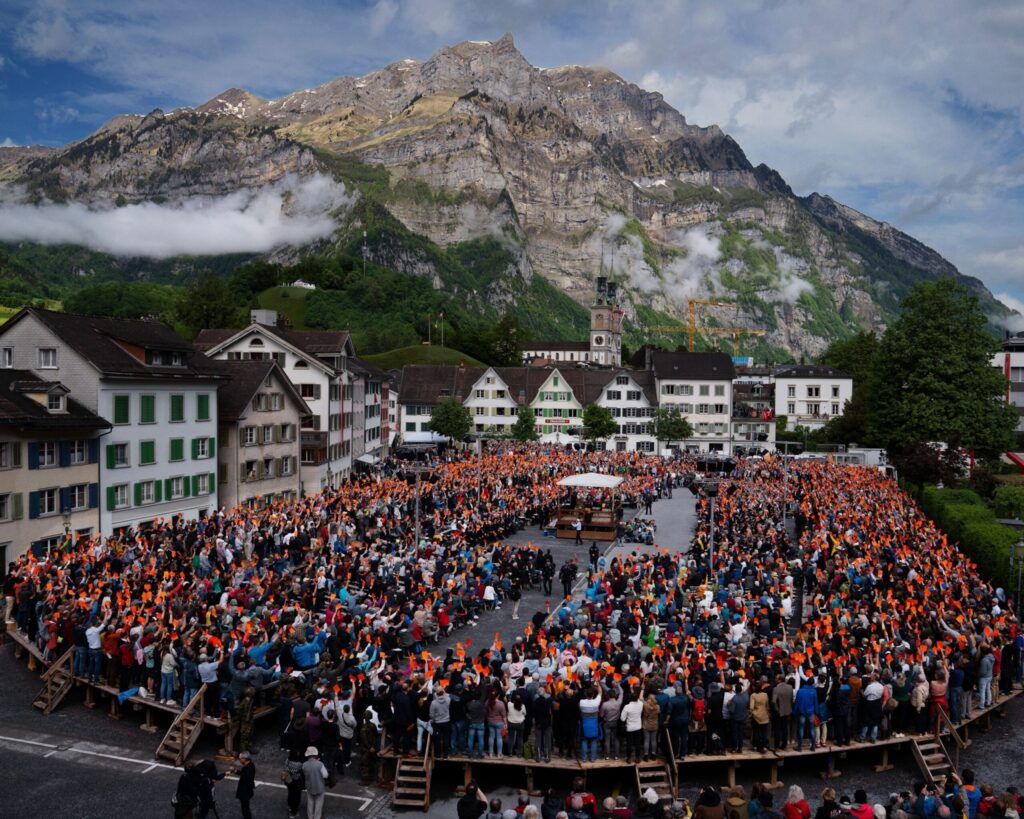
Switzerland strikes a balance between pure direct democracy and representative democracy. Therefore, its system is called Semi-Direct Democracy. Elected representatives handle day-to-day governance, while the people retain the right to have the final say on specific issues.
- Role of Representatives: The people elect the parliament (Federal Assembly) and the government (Federal Council) at the cantonal and federal levels. The parliament prepares laws and elects the government.
- Role of the People: Citizens possess the tools of Popular Initiative and Referendum to directly intervene in the laws and constitutional amendments passed by the Parliament. These mechanisms ensure the continuous sovereignty of the people.
✅ 4) Core Instruments of Direct Democracy (The People’s Powers)
The three main mechanisms that allow the people to intervene in the decisions of the government and parliament form the core of the system:
4.1 Popular Initiative (Volksinitiative / Initiative Populaire)
The Popular Initiative gives citizens the right to request an amendment to the Constitution.
- Process: A group of citizens can propose a constitutional amendment. For the proposal to be voted on at the federal level, 100,000 valid signatures must be collected within 18 months.
- Significance: This instrument empowers the public to directly set the political agenda and force debates on issues not prioritized by the government or parliament.
4.2 Mandatory Referendum (Obligatorisches Referendum)
The Mandatory Referendum requires that certain decisions be automatically submitted for popular approval.
- Subject: Any amendment to a constitutional article or accession to certain international organizations is automatically put to a popular vote.
- Requirement: A Double Majority (Popular Majority and Cantonal Majority) is required for this referendum to be accepted.
4.3 Optional Referendum (Fakultatives Referendum)
The Optional Referendum is the right of the people to veto a law passed by Parliament before it takes effect.
- Process: Citizens opposing an enacted law can demand that the law be put to a popular vote by collecting 50,000 valid signatures within 100 days of its publication.
- Significance: This tool subjects even ordinary laws passed by the legislature to the people’s control. For example, economic issues discussed in articles like Switzerland’s Minimum Wage and Average Salary: Facts and Illusions can be vetoed this way.
✅ 5) Initiative and Referendum Processes: Signatures and Deadlines
Instrument | Subject | Signatures Required | Deadline | Acceptance Requirement |
|---|---|---|---|---|
Popular Initiative | Constitutional Amendment | 100,000 | 18 Months | Double Majority |
Optional Referendum | New Federal Laws | 50,000 | 100 Days | Popular Majority |
Mandatory Referendum | Constitutional Amendments | Automatic | None | Double Majority |
✅ 6) The Double Majority Rule: The Power of the People and the Cantons
In the most critical issues (constitutional amendments and popular initiatives), a simple majority of the popular vote is not enough. The Double Majority (Volks- und Ständemehr) rule mandates the consent of two distinct majorities:
- Popular Majority (Volksmehr): More than half of the citizens participating in the vote must vote ‘Yes’.
- Cantonal Majority (Ständemehr): The majority of the 26 cantons (at least 12 full cantons and 2 half cantons) must vote ‘Yes’.
Protection Mechanism: This rule ensures that small cantons (regions with low populations) are protected against being overruled by the decisions of populous cantons like Zurich or Bern. This balance is the foundation of the country’s federal structure.
✅ 7) Popular Votes: Frequency and Diversity of Topics
Citizens in Switzerland go to the polls (mostly by mail) an average of 3 to 4 times a year.
- Diversity of Topics: The subjects cover every field of political life. This includes everything from rules on arms sales to pension reform, immigration quotas, and even the subsidization of cow horns.
- Three Political Levels: Citizens can vote on federal, cantonal, and municipal issues simultaneously. This intensity sometimes results in a single ballot envelope containing more than 15 different voting items.
✅ 8) The Role of Parliament: Consensus Democracy
The existence of direct democracy tools creates constant pressure for consensus on the parliament (Federal Assembly) and the government (Federal Council). This is known as Consensus Democracy (Konkordanzdemokratie).
- Counter-Proposal (Gegenvorschlag): When the government sees the risk of a Popular Initiative being accepted, it usually prepares a more moderate Counter-Proposal. This strategy offers the public a more acceptable alternative to the original proposition.
- Political Compromise: To minimize the risk of a law being vetoed by an Optional Referendum, the government must include all major parties, cantons, and interest groups in the law-making process.
✅ 9) Advantages and Criticism of Direct Democracy
Area | Advantages | Criticism |
|---|---|---|
Legitimacy | Decisions have very high legitimacy because they are approved by a broad majority of the public. | The decision-making process is very slow and long (debates can last years). |
Political Stability | Radical movements are suppressed because societal demands are incorporated into the system. | Occasionally, populist or irrational topics can be put to a vote (despite expert opinion). |
Education | Forces citizens to continuously research and debate political issues. | Voter turnout remains low (average 40–50%). |
✅ 10) focusAnaliz: Opportunities and My Thoughts
In my opinion, the greatest strength of this system is that the decisions of political authorities are never absolute and are open to public scrutiny at any time. This prevents the government from becoming arrogant and forces it to constantly gauge the public mood. The fact that the word of the people is supreme makes this system one of the best examples in the world.
Based on my observations, despite its flaws (especially the slow decision-making process), the strong balance, minority protection, and legitimacy provided by this system make Switzerland one of the most stable countries with the highest prosperity levels in the world. This system, which emphasizes that no one is superior to anyone else, underscores the equality of all peoples.
✅ 11) Frequently Asked Questions (FAQ)
Q: Why is voter turnout in Switzerland so low?
Answer: Average voter turnout is around 40–50%. The reason is that votes are held very frequently (four times a year) and the topics are very diverse. Citizens tend to vote only on issues that directly concern them. However, since the right to vote exists, low participation does not undermine the system’s legitimacy.
Q: What happens if a Popular Initiative succeeds?
Answer: If a Popular Initiative is accepted, the relevant article of the Federal Constitution is amended. This is the highest level of legal change. Parliament and the government are then obliged to make the necessary legal arrangements to implement this constitutional amendment.
Q: Where can I access the Swiss Federal Constitution?
Answer: The official, current text of the [Swiss Federal Constitution] is easily accessible via the official website of the Swiss Federal Government’s Official Legislation Site (Fedlex).
✅ 12) Alternatives and Advice
- Alternative: If direct democracy seems slow and confusing, you can focus on the veto power offered by the Optional Referendum and only vote on issues you oppose.
- Advice: When immigrating to Switzerland, research the ballot papers and get involved to understand how the country is governed. Integration begins with understanding these political processes.
✅ 13) Conclusion
Switzerland’s direct democracy system is the embodiment of coexistence and popular sovereignty. The word of the people is supreme. This may slow down the political structure; however, it grants the decisions made the highest national legitimacy. At the core of this unique system lies the principle that no one is superior to anyone else.