Driver’s License Exchange in Switzerland: Comprehensive Guide for EU/EFTA and Third-Country Nationals
Managing Your Foreign Driver’s License: The Critical 12-Month Period
Switzerland is known for its order and high living standards. For those settling in the country, one of the most important steps to maintaining personal mobility is converting a foreign driver’s license to a Swiss license. While the process is centrally regulated by law, the authority for implementation lies with the cantonal Road Traffic Offices (Strassenverkehrsamt).
As a chef living in Bern, I know the biggest confusion often arises from managing critical legal deadlines like the 12-month time limit for driver’s license conversion. This period starts from the date you officially register your residency in Switzerland. Exceeding this period can result in severe legal consequences, drastically limiting your mobility.
Below, we comparatively analyze the simplified procedure for EU/EFTA citizens and the high-risk Control Drive (Kontrollfahrt) process for Third-Country Nationals.
focusAnalysis: The Exchange is Proof of Driving Competence
Working as a chef in Bern in a low-wage sector, I know what it means to still have bureaucratic tasks hanging over your head even after an 8-10 hour intensive shift.
My focusAnalysis is: The mandatory Control Drive (Kontrollfahrt) for Third-Country Nationals is not a simple driving skills test, but proof that you have adapted to Switzerland’s high standards of safety and traffic regulations.
This regulation underscores the importance Switzerland places on driver competency. The single attempt rule transforms the process from a mere administrative exchange into a high-risk competency test, measuring the driver’s technical and cultural integration into the Swiss traffic system.
Comparison Matrix of Driver’s License Exchange Processes: Who Needs to Take an Exam?
The process for converting foreign driver’s licenses in Switzerland relies on fundamentally different legal regimes for EU/EFTA and Third-Country Nationals.
Criterion | EU/EFTA Nationals | Third-Country Nationals (Non-Exempted Countries) |
|---|---|---|
Basic Procedure | Administrative Exchange (Direct Swap) | Control Drive (Kontrollfahrt) Obligatory |
Legal Basis | Mutual Recognition, VZV Art. 42 | Competency Assessment, VZV Art. 29 and 42 |
Control Drive Required | Generally Exempt | Mandatory (45-minute practical test) |
Attempts Allowed | N/A | Single Attempt |
Critical Risk | License held for less than 1 year (Probationary License) | Failure on Control Drive (Total loss of driving entitlement) |
Estimated Cost (Incl. Training) | Low | High (Due to mandatory professional preparation lessons) |
Administrative Framework and Legal Foundations: Universal Rules
The conversion process for foreign nationals settling permanently in the Swiss Confederation is based on central legal regulation, but the authority for implementation belongs to the cantonal Road Traffic Offices (Strassenverkehrsamt).
📌 Federal Legal Basis and Jurisdictional Distribution
The process is governed primarily by the Federal Road Traffic Act and specifically Articles 42 to 44 of the Road Traffic Licensing Ordinance (VZV). The processing, acceptance of documents, and final issuance of the license fall under the administrative jurisdiction of the canton’s Strassenverkehrsamt. This means that while the core principles are federal, practical application and fee structures can show cantonal variations. For more information on The 26 Swiss Cantons: Guide to Administration, Population, and Languages and their administrative differences, you can read our article.
💰 The Critical 12-Month Rule and Legal Consequences
The most critical and universal rule in license conversion is the 12-month time limit granted to all foreign drivers settling in Switzerland. This period begins from the date the person officially registers their residency.
Driving is allowed with a valid foreign license during this 12-month period. However, upon expiration, the foreign license becomes completely invalid in Switzerland. If the foreign driver has not converted their license after this period, they cannot operate a motor vehicle on Swiss soil until they regain the right to drive.
🚦 Mandatory Basic Application Requirements
Regardless of citizenship or the license’s origin, every applicant must fulfill these basic administrative steps:
- Mandatory Vision Test (Sehtest): This must be conducted by an authorized optician or ophthalmologist in Switzerland.
- Form Completion: The “Application for the Exchange of a Foreign Driver’s License” (Gesuch um Umtausch eines ausländischen Führerausweises) must be filled out and signed.
- Transition to Card Format: All individuals converting a foreign license automatically receive the new Swiss license in the internationally compliant card format.
Document | Requirement Status | Notes |
|---|---|---|
Completed Application Form (Gesuch) | Mandatory | To be obtained from the cantonal Strassenverkehrsamt. |
Foreign License (Original) | Mandatory | Submitted during the application. |
Valid Residence Permit (Ausländerausweis) | Mandatory | Required for identity verification. |
Vision Test Certificate (Sehtest) | Mandatory | Swiss optician/doctor; valid for 2 years. |
Current Passport Photo | Mandatory |
Simplified Procedure for EU/EFTA Nationals (Administrative Exchange)
Driver’s licenses from the European Union (EU) and the European Free Trade Association (EFTA) enjoy a special status in Switzerland and are generally subject to an administrative exchange procedure. This simplified process largely eliminates the requirement for a practical driving test.
🌍 Conditions for Administrative Exchange
EU/EFTA licenses are fully and directly recognized under Swiss law. These citizens can exchange their foreign license for a Swiss one within 12 months of settling in Switzerland, without taking any driving or theoretical exam.
📌 Exception: The Probationary License (Führerausweis auf Probe)
The most notable exception relates to the age of the license. If the foreign license was obtained less than one year before settling in Switzerland, the EU/EFTA national is issued a Probationary License (Führerausweis auf Probe) instead of a direct permanent Swiss license. This probationary license is subject to the rules applicable to novice drivers in Switzerland, including the mandatory Advanced Training Course (WAB) obligation.
✈️ Administrative Processes Post-Exchange and International Dimension
After the application is approved, the Swiss authorities do not destroy the exchanged foreign license but return it to the issuing authority (e.g., an EU country’s authority).
This can create a future legal challenge for EU citizens planning to return to an EU country after residing in Switzerland. The Swiss license they hold will be considered a “foreign license” under the legislation of the returning EU country. This may necessitate managing short administrative conversion periods upon returning home.
High-Risk Procedure for Third-Country Nationals: The Control Drive Requirement
The conversion of driver’s licenses from countries outside the EU/EFTA (Third Countries) requires a mandatory practical proficiency test called the Control Drive (Kontrollfahrt). Nationals from non-exempted countries must undergo this practical competency test.
❓ Why the Control Drive? Third-Country Status
The VZV presumes that the traffic regulations and driver training standards of certain countries may not be considered directly equivalent to Swiss safety and proficiency levels. Since these countries lack a direct mutual recognition agreement with Switzerland, the conversion is conditional on the applicant proving their compliance with Swiss traffic rules and driving standards.
🗓️ Procedural Steps and 12-Month Time Management
The process for a Third-Country National proceeds as follows:
- Application: The conversion application is submitted to the Strassenverkehrsamt with all necessary documents.
- Control Drive Requirement: The Strassenverkehrsamt mandates the Control Drive.
- Appointment Scheduling: The candidate must receive the appointment for and successfully complete the Control Drive before the 12-month legal driving period expires. Given training and waiting times, applying in the first months is crucial. For more information on Swiss Residence Permits (B, C, L): Which One is Right for You? and how they relate to deadlines, you can read our article.
⚠️ Risk Management: The Single-Attempt Mechanism
The Control Drive process is high-risk because it is, as a rule, limited to a single attempt.
- Legal Consequences of Failure: If the candidate fails the Control Drive, the foreign license’s validity in Switzerland is immediately revoked. This results in the total loss of the right to drive, and the person must start the license acquisition process from scratch in Switzerland (including first aid courses, theoretical exams, driving lessons, and a full practical exam).
- Cost and Time: Starting from scratch is far more time-consuming and costly than a simple conversion.
Control Drive (Kontrollfahrt) Analysis: Technical Excellence and Local Adaptation
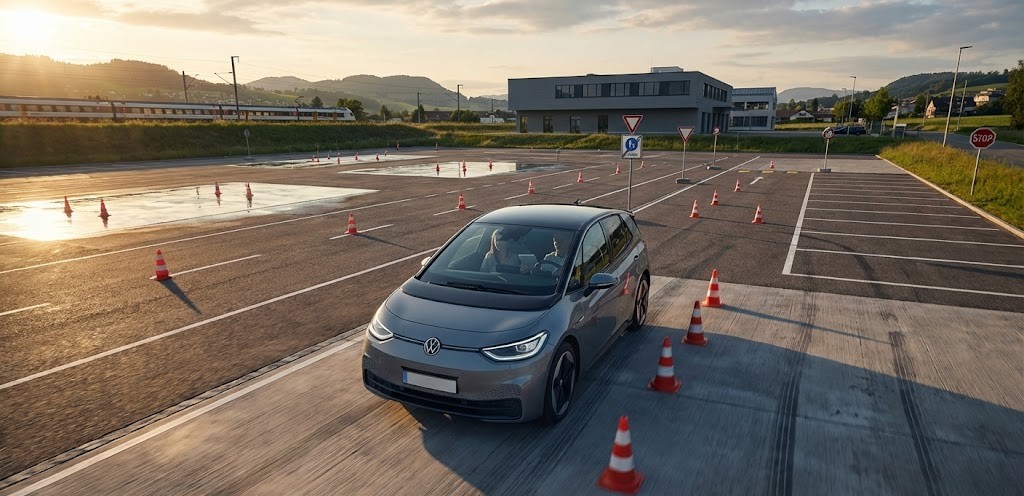
The Control Drive is a 45-minute practical exam designed to prove that foreign drivers possess adequate safety and skill in Switzerland’s demanding traffic environment and high regulatory standards.
🛣️ Exam Content and Standard Technical Checks
The Control Drive tests the driver’s ability to manage traffic flow and react to unexpected situations, beyond basic vehicle control skills. Experts look closely at compliance with local traffic culture.
🚦 Critical Elements of the Swiss Driving Style
The complexity of the exam stems from the driver’s adaptation to local traffic culture. Examiners test mastery of scenarios unique to Switzerland or complex traffic situations:
- Begegnungszonen (Encounter Zones): Driving in these areas is a key part of Swiss traffic etiquette. The driver is expected to drive slowly (max 2nd gear), with their foot near the brake, demonstrating good visibility technique in low-visibility passages. For more on Swiss Rules of Life: Order, Silence, and Adaptation Guide and adherence to local rules, you can read our article.
- Complex Intersections and Lane Selection: In large cities (e.g., Bern or Zurich), multi-story roundabouts, double roundabouts, and areas with heavy tram lanes are particularly challenging.
📚 Professional Preparation Strategies and Costs
Given the single attempt and the severe consequences of failure, professional preparation is practically mandatory.
- Local Expertise: Experienced driving instructors know the typical testing routes used by the Strassenverkehrsamt, the specific maneuvers tested, and the canton-specific critical points (e.g., the 7-arm roundabout in Bern).
- Cost Factor: The official exam fee (ranging from 100 CHF to 200 CHF) is only a small part of the total cost. The primary cost for Third-Country Nationals comes from the professional preparation lessons (90 CHF to 150 CHF per hour) taken to manage the single-attempt risk. For more on Switzerland’s Minimum Wage and Average Salary: Facts and Illusions and the financial burden of these preparations, you can read our article.
Cantonal Application Differences and Cost Comparison
The administrative processing by the cantonal Strassenverkehrsamt leads to procedural and cost differences.
📝 Cantonal Variations in Strassenverkehrsamt Procedures
While the basic documents are federally standardized, the method of document submission varies by canton.
- Example Canton of Zurich (ZH): Applicants often must appear in person for on-site identification (Identifikation vor Ort), for which an additional fee is charged (CHF 20).
- Examples Basel-Stadt (BS) and St. Gallen (SG): Some cantons explicitly state that administrative measures or compliance checks are conducted during the exchange, meaning the applicant’s past traffic record and residency history in Switzerland may also be examined. For more on Family Reunification in Switzerland: Visa Process for Spouse and Child and how residency history is scrutinized, you can read our article.
Criterion | Service Description | Fee (CHF) | Notes |
|---|---|---|---|
Zug (ZG) | Issuance of Card Format License | 40.00 | |
Bern (BE) | Conversion of Probationary to Permanent License | 30.00 | |
Zurich (ZH) | On-site Identification | 20.00 | |
General | Control Drive Exam Fee | 100 – 200 | Varies by canton. |
General | Driving Instructor Preparation Lesson (45 min) | 90 – 150 | The biggest cost item for Control Drive candidates. |
Alternatives, Exceptions, and Special Cases
This section addresses two special cases that differ from the main conversion process:
⚠️ The Probationary License Requirement (Führerausweis auf Probe)
This applies to EU/EFTA nationals whose license was obtained less than one year before arriving in Switzerland. These EU citizens receive a Probationary License, subjecting them to the rules applicable to novice drivers in Switzerland, including the mandatory Advanced Training Course (WAB) and a typical three-year probationary period.
✈️ Legal Challenge in International Mobility
For EU citizens who exchange their license for a Swiss one, a new administrative challenge arises if they plan to return to an EU country later. Since Swiss authorities return the original EU license, the Swiss license they hold upon returning is considered a “foreign license” by that EU country. This may necessitate managing short administrative conversion periods upon returning home.
❓ Frequently Asked Questions (FAQ)
❓ Question: Can I convert my Foreign License after the 12-Month Period has Expired?
✅ Answer: No. Legally, your foreign license becomes completely invalid in Switzerland after the 12-month period expires. If this deadline is missed, you must initiate the license acquisition process from scratch to regain the right to operate a motor vehicle in Switzerland.
❓ Question: Can I use my own car for the Control Drive?
✅ Answer: Yes, you generally can, provided your vehicle meets Swiss legal and technical requirements (valid insurance, inspection, etc.). However, if you are preparing with a professional instructor, using the instructor’s dual-control, insured vehicle is the safer and more practical option.
❓ Question: If I fail the Control Drive, must I also retake the theoretical exam?
✅ Answer: Yes, if you fail the single attempt. Failure results in the total revocation of your foreign driving entitlement, forcing you to begin the process from the very start, which includes taking the Theoretical Exam and the mandatory First Aid Course (Nothelferkurs) and Traffic Knowledge Course (Verkehrskundeunterricht).
Comparative Analysis and Conclusion
The driver’s license exchange process in Switzerland is based on fundamentally different legal regimes for EU/EFTA and Third-Country Nationals.

✅ Conclusion and Recommendations
The analysis shows that the 12-month time limit is an absolute legal constraint for all foreign drivers settling in Switzerland. This period is central to process management and must never be exceeded.
- For EU/EFTA Nationals: While the process is administratively simple, those who obtained their license less than one year before coming to Switzerland must be careful regarding the Probationary License (Führerausweis auf Probe) regime and the WAB training obligations.
- For Third-Country Nationals: The single attempt rule for the Control Drive means this exam serves as a high-risk tool that challenges the candidate’s technical and cultural integration into Swiss traffic regulations. Since failure means the obligation to acquire a license from scratch, it is essential to take specialized lessons for the Control Drive from a competent and locally knowledgeable driving instructor to avoid the loss of time and resources. Using the correct lane in complex multi-cantonal roundabouts in Bern, for instance, proves the local mastery required. For comprehensive details on cantonal differences, you can read our article on The 26 Swiss Cantons: Guide to Administration, Population, and Languages. This preparation is the key to successfully completing the administrative conversion process.