THE UNKNOWN SIDE OF SWITZERLAND: SMALL VILLAGES, GREAT STORIES: QUIET ROUTES AND HIDDEN HERITAGE
focusAnalysis: Instead of Watching Switzerland from an Aquarium, Open the Door to Adventure!
What comes to mind when you think of Switzerland? Probably trains that run like clockwork, banks, and a perfect, albeit slightly boring, order, right? Some international critics even compare the country to an “aquarium watching the outside world from behind bulletproof glass”. It seems Switzerland, in its majestic isolation, could become fragile against international shocks, like unexpected U.S. tariffs. It is exactly at this point that I will share a big secret with you: the real Swiss stories are hidden far beyond that polished surface!
If you are tired of the main tourist routes and want to experience authentic Swiss life, you are in the right place. This report proves that Switzerland is not merely a place “without history” after a small civil war that lasted 26 days in 1847. On the contrary, we will discover how the country’s cultural diversity, historical depth, and warm identity are preserved in small towns and mountain villages, far from the crowds of big cities.
Get ready! We are embarking on a journey to four legendary, hidden Swiss villages whose destiny was shaped by their geography and which are protected even by the Federal Inventory of Sites of National Importance (ISOS): Soglio, Evolène, Saint-Ursanne, and Samnaun. The great stories of Alpine traditions and local identities await us!
Stories Sown by Geographical Isolation: The Depths of the Canton of Graubünden
Graubünden (Grisons), Switzerland’s largest holiday region, is a true natural wonder with its untouched nature and picturesque villages. The stories of the communities here are full of striking examples of how geography created both difficulties and unique advantages.
Soglio: The Balcony to Paradise (Val Bregaglia’s Hidden Gem)
Although Soglio is very close to the famous St. Moritz, it is a charming mountain village that has remained on the “undiscovered route,” as if reserved just for you. The feeling you get when you arrive there is exactly what the famous painter Giovanni Segantini called “The Threshold to Paradise”.
Detailed Information on Background and Geography
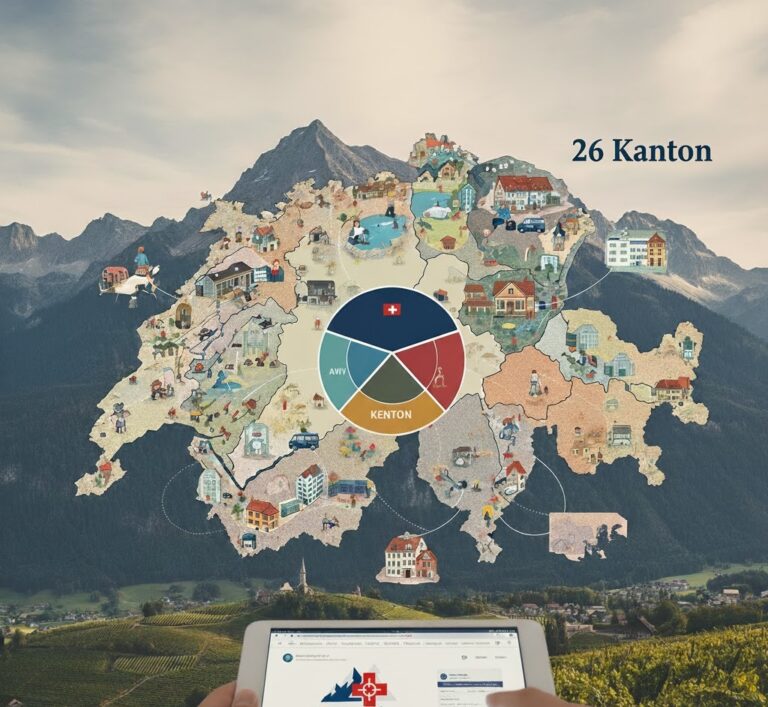
If you want to understand the geographical and administrative details of Switzerland more deeply, we recommend our article: [The 26 Swiss Cantons: Guide to Administration, Population, and Languages].
The Magic of the Scenery and the Shadow of the Von Salis Family
When you stroll through Soglio’s narrow, cobbled streets, it’s natural to feel like you are in a postcard. The village overlooks the majestic peaks of Val Bondasca (like Piz Badile and Piz Cengalo) exceeding 3,000 meters. Furthermore, the village is located on a cultural and climatic threshold where the Alpine climate transitions into a Mediterranean breeze.
But why is such a small village so magnificent? The answer lies in the Von Salis Family. Soglio’s magnificent architecture is the legacy of this family, the dominant political force in the region from the 16th to the 18th century. You must visit the Palazzo Salis in the heart of the village, built in 1630 and operating as a hotel since 1876. This palace, which hosted great artists like Rainer Maria Rilke and Alberto Giacometti, is like an art gallery defying time.
Chestnuts, Art, and Regional Innovation
The Bregaglia Valley is also famous as the “Valley of Art,” having produced artists like Alberto Giacometti and Giovanni Segantini. The valley’s identity is closely tied to the chestnut groves, introduced by the Romans and among the largest in Europe. Don’t miss the annual Chestnut Festival if you visit in October.
Soglio’s path to adaptation to the modern world is inspiring: The initiative Soglio-cosmetics creates regional economic value using raw materials from the mountain regions. This proves that Soglio is not only living in the past but also shaping the future!
Samnaun: The Duty-Free Shopping Paradise (A Privilege Created by Geography)
Samnaun is unique as Switzerland’s only duty-free zone. This, however, is not a privilege but a result and necessity of geographical isolation in the 19th century. This is a story of a small community’s triumph against the state.
The 1848 Crisis and Resistance to Federal Injustice
When the modern Swiss state was founded in 1848, national borders became customs borders. However, the Samnaun Valley had no direct road connection from Swiss territory; the only route was through Austria. The people of Samnaun not only couldn’t access their own domestic market but were also forced to pay customs duties for goods brought into the country, which was a huge blow to farmers.
Duty-Free Status: A Crisis Turns into a Lasting Advantage
Here is the triumph of the struggle: in the face of the Samnaun people’s efforts for survival, the Swiss Federal Council granted the Samnaun Valley duty-free status in 1892. Although the Samnaunerstrasse road was opened through Swiss territory in 1912, this status became permanent!
Today, Samnaun consists of five separate settlements and rapidly developed into a center for winter tourism due to its duty-free status. Tourism management (TESSVM) strives to balance this economic advantage with eco-friendly (climate-neutral) and social responsibility principles. This region is a great example of how geographical disadvantage can be transformed into a political exception through local determination.
Guardians of Identity: Language, Legend, and Folklore
The soul of Switzerland lies in the linguistic and folkloric conservatism of settlements like Evolène and Saint-Ursanne, which have managed to remain isolated. This is a true “cultural time capsule.”
Evolène (Valais): The Language of the Heart and the Mystery of the Primitive Carnival
Evolène, located in Val d’Hérens, is one of the Swiss villages that preserves its traditions most strictly. Its story is a passionate resistance against modernization, waged through language and rituals.
Patois d’Evolène: Spoken History
Evolène is one of the rare places in Canton Valais where Patois (Arpitan) is still spoken! This Romance dialect is not merely a simple dialect but a rich, millennia-old treasure. It contains Latin origins, as well as pre-Roman words (like lù bârma, the hanging rock) and elements borrowed from Germanic languages.
The Patois, dubbed the “language of the heart” by locals, is a system of values that holds the entire community together through legends, stories, and unchanging expressions. The survival of Patois in Evolène is tangible proof of the local identity’s stubbornness!
Thrilling Rituals: Fur Masks and the Judgment of Winter
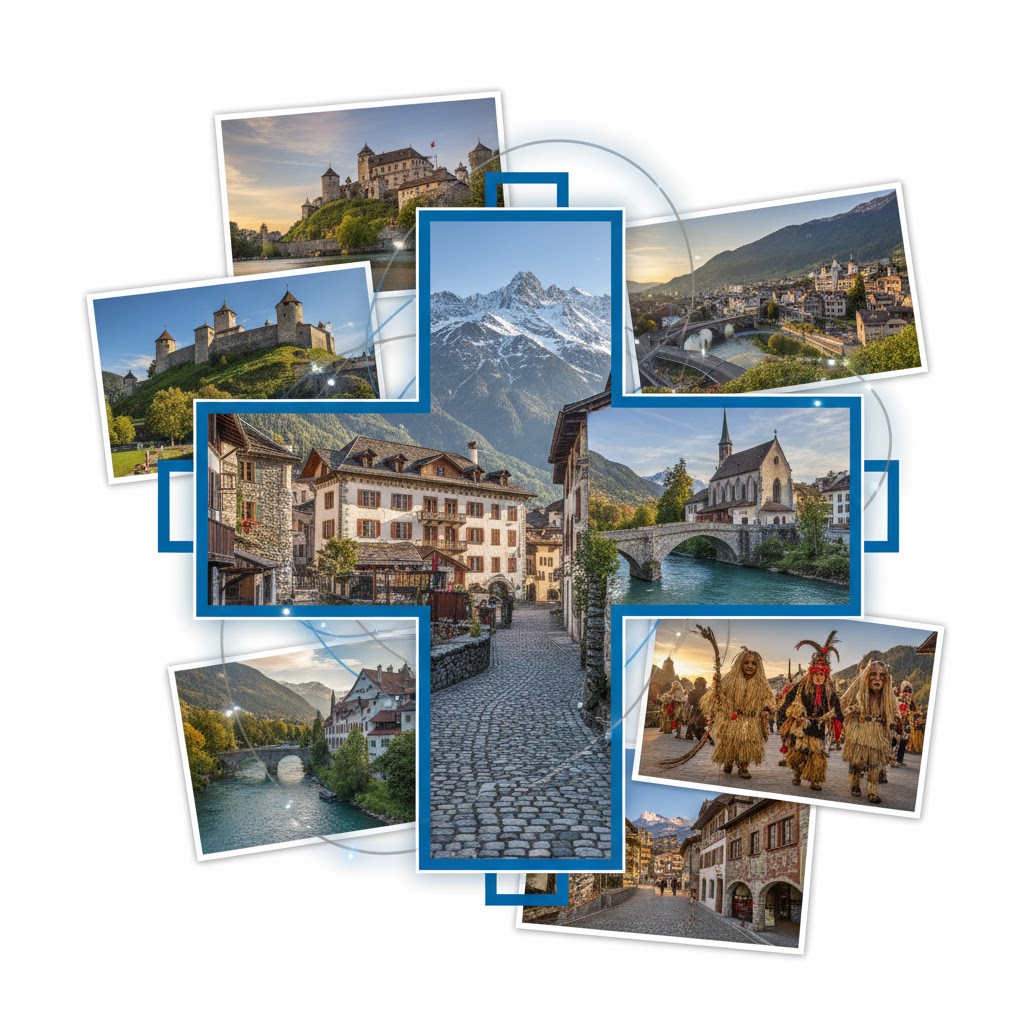
The Evolène Carnival is a visual feast and a primitive ritual! Celebrating the end of winter and the arrival of spring, this carnival is unique among European traditions; it is the only one that still insists on using straw and animal furs for its costumes.
The masks? They are carved from wood, representing figures of the devil, lion, or monster with human characteristics. The most intriguing moment of the rituals is the trial and burning at the stake of the poutratze (the winter man), the personified form of winter. A quick burning signals a hot summer; a slow burning suggests a rainy summer.
Saint-Ursanne (Jura): The Monk, the Bear, and the Hidden Worker Town
Saint-Ursanne, situated in the Canton of Jura along the winding course of the Doubs River, is a dazzling town that has nearly perfectly preserved its medieval character. Its depth lies in the striking contrast between the mysticism of its founding legend and the social history of the 20th century.
The Legend of Saint Ursicinus: The Bear and the Donkey
The town’s founding story is a film script in itself! According to legend, the Irish monk Saint Ursicinus settled here in the 7th (or 6th) century to live in solitude. How? A bear ate the monk’s donkey! The monk settled in this isolated cave, and a monastery was later established around him.
Hidden Social Monument: The 1918 Worker Settlement
Ready to hear the most intriguing secret hidden within the medieval walls? Just across the river is a small worker settlement dating back to 1918, a testament to the town’s industrial past.
This settlement is a local record of the social tensions experienced during the National General Strike of 1918, the biggest internal crisis in modern Swiss history. Saint-Ursanne has a complex identity shaped not only by sacred legends but also by the history of the working class.
Fantastic Transformation: Dragons and the World of Fantasy
Today, Saint-Ursanne has found the most creative ways to blend its historical heritage with modern tourism. Events like “Saint-Ursanne la Fantastique” and Circuit Secret, led by The Lord of the Rings illustrator John Howe, adorn the medieval center with dragons, unicorns, and other fantasy motifs.
Historical Period | Concrete Structure/Legend | Cultural Significance |
|---|---|---|
7th Century (Early Middle Ages) | Hermitage of St. Ursicinus and the Bear Legend | The town’s sacred founding myth and mystical basis. |
12th – 16th Century (Middle Ages) | Collegiate Church, Monastery, and Three Town Gates | Religious and feudal defense architecture. |
1918 (20th Century) | Small Worker Settlement | Local record of social tensions and industrial past. |
Contemporary Period | John Howe Art Projects (Circuit Secret) | Revitalization of historical heritage with fantasy themes. |
The Swiss Cultural Mosaic and Unexplored Jewels
Switzerland is not merely comprised of four main linguistic regions; it is a vibrant mosaic of countless micro-cultures and geographical identities. The stories of these small settlements help us understand the full extent of the country’s diversity.
Other Gems Waiting to be Discovered
Ticino’s Mediterranean Passion: Ticino, at the southern tip of Switzerland, represents the country’s Italian flair. Towns like Ascona on the shores of Lake Maggiore and Morcote, famous for its breathtaking location, prove how “Mediterranean” Switzerland can be.
Aesthetic of Historic Towns: Other towns listed in the ISOS inventory like Murten (Morat) and Stein am Rhein reinforce Switzerland’s hidden richness with their striking historic textures, free from large crowds.
Although geographical barriers exist everywhere in Switzerland, each village has reacted differently to this isolation:
Village | Type of Isolation | Adaptation/Outcome | Preserved Heritage |
|---|---|---|---|
Samnaun | Geographical (lacked national road until 1912) | Economic exception (Duty-free zone) | Border Economy and Tax Advantage |
Evolène | Valley Isolation (Val d’Hérens) | Linguistic and ritualistic conservatism | Rare Patois Dialect and Primitive Carnival |
Soglio | High Terracing (Val Bregaglia) | Preservation of historical architecture and art | Von Salis Palaces and Chestnut Culture |
Saint-Ursanne | Doubs River Bend (Jura) | Coexistence of religious and industrial history | Saint’s Legend and 1918 Social History Record |
Conclusion: These Great Stories Await You!
As you can see, the unknown side of Switzerland is full of deep, complex, and exciting stories!
These small communities offer a unique contribution to the national identity, not only through their beauty, but also through:
- Cultural Resilience (Patois language and primitive Carnival rituals in Evolène)
- Economic Ingenuity (Duty-free status of Samnaun)
- Historical Contradictions (The coexistence of the monk legend and the worker settlement in Saint-Ursanne)
These hidden Swiss jewels promise you a personal and unforgettable adventure away from the crowds. Now is the time to break the glass of that aquarium and discover the real stories echoing in the Alpine valleys! Happy travels!