Switzerland UNESCO World Heritage: A Guide to 13 Nature and Culture Wonders, their Protection Status and Critical Travel Tips
Introduction: A Giant, Perfectly Protected Microcosm
One of the cornerstones of Switzerland’s international reputation is its portfolio of UNESCO World Heritage Sites, which are meticulously protected on its territory. Since the initial signing in 1975, this portfolio now comprises a total of 13 sites, ranging from Alpine peaks to prehistoric settlements. These sites are not merely tourist attractions; they are the tangible manifestation of the country’s federal administration, consensus culture (Concordance), and long-term planning philosophy.
A Governance that Deserves Respect
This immaculate protection, which has gone hand-in-hand with nature for decades, is a constant reminder of why life in this country is almost felt as a “necessity.” They are so well-preserved and so perfectly planned that they truly deserve their name. For me, these sites are not just fascinating landscapes, but they showcase why these people and their system command so much respect. This sensitivity instills in even a foreigner a deep sense of belonging and gratitude for the geography in which they find themselves. This article is an expert-based guide that allows you to visit Switzerland’s 13 wonders while understanding the underlying geopolitical and conservation efforts. For a more comprehensive overview, you can consult our main article Everything You Need to Know About Switzerland — The Comprehensive Guide.
1. The Swiss World Heritage Portfolio: Overview and Management Focus
As of 2021, Switzerland has a total of 13 properties inscribed on the UNESCO World Heritage List. Nine of these are cultural properties and four are natural properties. The Swiss administration, led by the Federal Office of Culture (FOC) and the Federal Office for the Environment (FOEN), has strategically put new applications on hold until 2028 to focus on consolidating existing sites and adhering to international regulations (e.g., Periodic Reporting Cycle 3 – PR3).
1.1. Transnational Sites: The Geopolitical Test of Governance
A notable feature of the portfolio is that a total of five out of the 13 sites (38%) are transnational, meaning their management requires multilateral cooperation beyond Switzerland’s national borders.
Site Name | Inscription Year | Type | Transnational Status | Note on Management/Reporting |
|---|---|---|---|---|
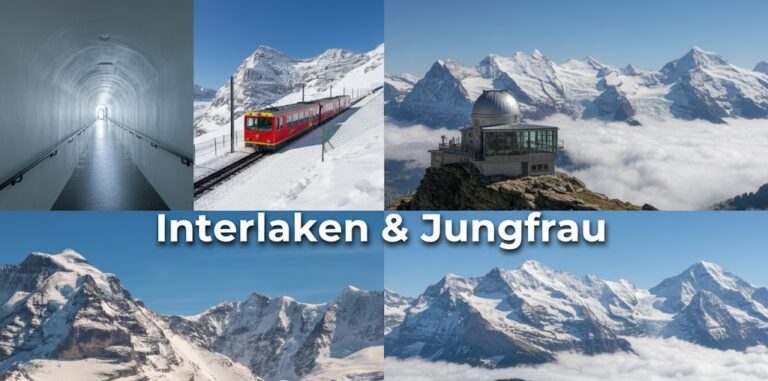
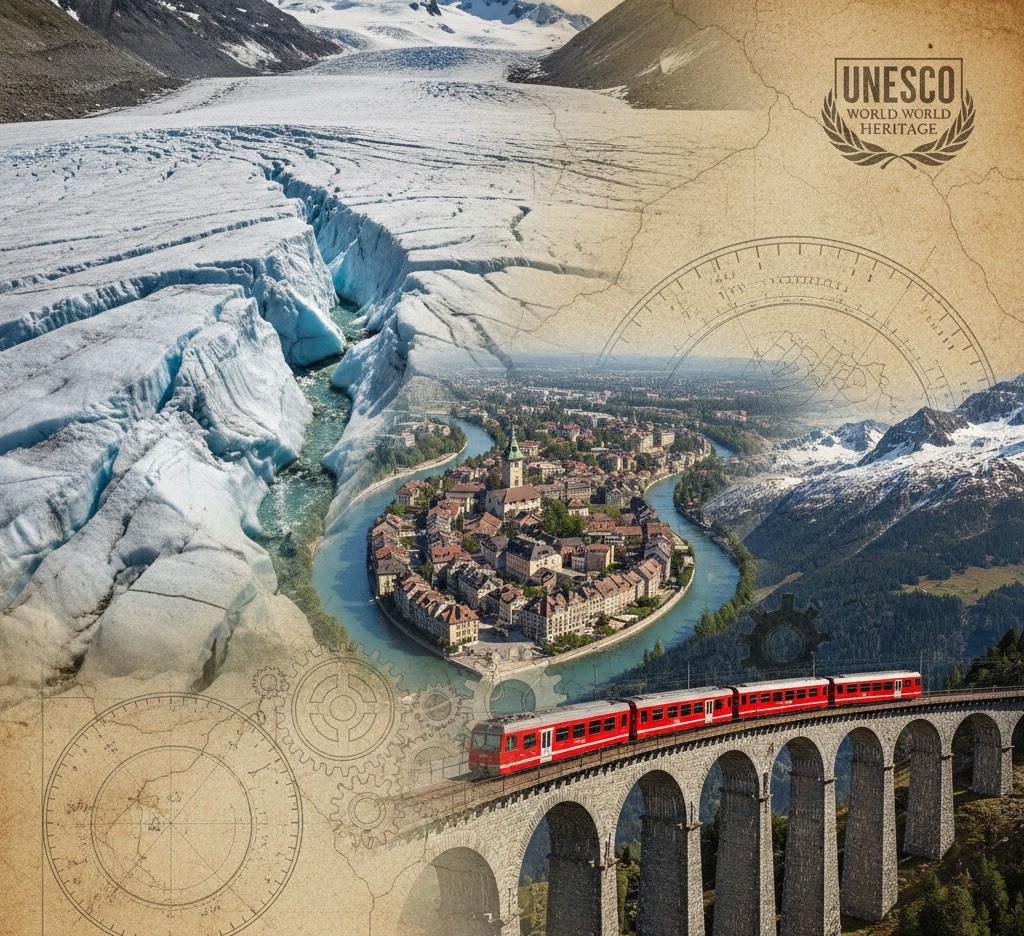
Swiss Alps Jungfrau-Aletsch | 2001, 2007 | Natural | No | High threat from climate change, Management Highly Effective. |
Monte San Giorgio | 2003, 2010 | Natural | Yes (Italy) | Lack of a cross-border management body is a strategic weakness. |
Rhaetian Railway in the Albula/Bernina Landscapes | 2008 | Cultural | Yes (Italy) | Operational authenticity preserved, public presentation needs improvement. |
Three Castles of Bellinzona | 2000 | Cultural | No | The castles, walls, and fortifications of Bellinzona. |
Old City of Bern | 1983 | Cultural | No | The management plan (previously missing) is now mandatory. |
Lavaux, Vineyard Terraces | 2007 | Cultural | No | Example of a unique cultural landscape. |
Ancient and Primeval Beech Forests of the Carpathians and Other Regions of Europe | 2021 | Natural | Yes (17 countries) | Most recently added site. |
6 Other Sites | 1983–2016 | Cultural/Natural | Various | Abbey of St Gall, Sardona Tectonic Arena, Architectural Works of Le Corbusier, etc. |
2. Critical Case Study 1: Swiss Alps Jungfrau-Aletsch
Inscribed in 2001 and 2007, this Natural Heritage Site is Switzerland’s most important focus regarding environmental threats and adaptive management strategies.
2.1. The Overwhelming Threat of Climate Change
The primary factor threatening the Outstanding Universal Value (OUV) of the region is Climate Change. Continuous glacier retreat severely impacts the site’s values in the long term.
- Critical Glacier Shrinkage: In 2022 and 2023, Switzerland’s glacier volume shrank by approximately 10%. Climate models predict an almost complete loss of ice volume by 2100, depending on the global emissions scenario.
- Secondary Risks: Glacier retreat and the associated permafrost thaw trigger secondary geological instabilities.
2.2. Management Effectiveness and Policy Conflict
The World Heritage Management Centre Swiss Alps Jungfrau-Aletsch (MZ SAJA) was rated as Highly Effective in the IUCN Nature Outlook 2025.
Parameter | Status/Trend | Explanation |
|---|---|---|
Management Effectiveness | Highly Effective | Successful complex management system involving local and national stakeholders. |
Primary Long-Term Threat | Climate Change | Glacier retreat and increasing slope instability. |
Developing Threats | Hydropower/Renewable Energy | Changes in the Federal Act on Nature Protection have facilitated the establishment of renewable energy facilities in protected areas. This creates a conflict between OUV and national energy goals. |
Even federal laws establishing the legal framework, such as Immigrant Rights and Obligations in Switzerland, can come into conflict with the OUV of such natural heritage sites. This situation represents the most current policy tension in the Swiss system.
2.3. Dynamic OUV: The Paradox of Retreat
Although the glacial landscape is under threat, areas becoming ice-free create new habitats for biodiversity, colonization, and faunal habitats. This signals that the site’s OUV is shifting from a static glacial display to a critical living laboratory for rapid ecological and biological processes. Management must evolve from static protection to a philosophy that safeguards this adaptive and dynamic change.
3. Critical Case Study 2: Monte San Giorgio and Structural Weakness
Inscribed in 2003 and 2010, Monte San Giorgio (jointly with Italy) exemplifies persistent structural weaknesses requiring diplomatic solutions, despite Switzerland’s general commitment to high management quality.
Lack of Cross-Border Management
The national UNESCO World Heritage Action Plan has clearly emphasized the requirement to establish a resourced cross-border management body for Monte San Giorgio with Italy. This is a critical administrative issue that has been called for since the 2010 extension. The persistent weakness signals that, while matters under national control (FOC/FOEN) are advanced quickly, structural issues requiring external coordination and a diplomatic solution remain.
4. Route for Culture and Technical Heritage and Travel Tips
In addition to natural wonders, the UNESCO sites in Switzerland include cultural routes that reflect the country’s engineering spirit, history, and local culture.
4.1. Rhaetian Railway in the Albula/Bernina Landscapes (Technical Genius)
- Feature: With 42 tunnels and 144 viaducts/bridges, it is an outstanding example of the use of railways to overcome the isolation of settlements in the Central Alps at the beginning of the 20th century.
- Travel Tip: To experience this route, you should use the Bernina Express or Glacier Express lines, which preserve the authenticity of the railway operation. The public presentation of the site is still being improved. Therefore, plan your journey in advance to focus on the technical and historical details.
4.2. Lavaux, Vineyard Terraces (Cultural Landscape)
- Feature: This cultural landscape, stretching across the steep slopes on the north shore of Lake Geneva, is a testament to centuries of wine production and the local population’s adaptation to nature.
- Travel Tip: To experience the silence of Switzerland’s Concordance culture and enjoy Lavaux, you should set aside the feeling of safety and stability that the country offers through topics like How Does the Swiss Pension and Social Security System Work?, and walk the small village paths in the region. Here, the harmony of nature and human labor embodies the peace of the country.
4.3. Old City of Bern and Urban Planning
- Feature: The Old City of Bern, inscribed in 1983, reflects the efforts of the Office of Culture (FOC) to reconcile Sustainability Goals with urban heritage by integrating modern building technologies (heating, ventilation, air conditioning) for energy efficiency without disturbing the historic appearance of roofs and facades.
- Travel Tip: Try to perceive this administrative sensitivity when visiting Bern: observe how modern life (trams, shops) is interwoven with centuries-old architecture and how social elements, as described in Social Life in Switzerland: Neighborhoods, Festivals, and Leisure Activities, are protected within this historical fabric. These sites also reflect the systematic order of the country, which is covered in The Comprehensive Immigration Guide for Switzerland: Visa, Bureaucracy, and the Path to Successful Integration.
Conclusion: World Heritage Management as a Mirror of National Identity
Switzerland’s UNESCO World Heritage portfolio is not only a fascinating travel itinerary but also a summary of the country’s political philosophy, technological competence, and long-term environmental commitment.
Although reports assess management effectiveness (rated Highly Effective in the Jungfrau-Aletsch case) as generally strong, the existential threat of climate change and structural gaps like at Monte San Giorgio show that the country still has critical geopolitical and administrative challenges to address.
The trust and admiration a visitor feels for these sites are the result of the Swiss strategy of focusing on qualitative management rather than quantity, and the silent success of Concordance. These sites are the most concrete evidence of why Switzerland has built a system that should serve as a model for the entire world. This success is also a product of the political structure, which is explored in Direct Democracy: Why and How the Swiss People Vote on Everything.
Frequently Asked Questions (FAQ)
Q: Which site is currently on Switzerland’s Tentative List?
A: As of 2021, only one property is on the tentative list: The Salginatobel Bridge (Grisons, 2017), designed by Swiss civil engineer Robert Maillart. New applications have been strategically deferred until 2028.
Q: Which site in Switzerland is most threatened according to UNESCO?
A: The Swiss Alps Jungfrau-Aletsch (Natural Heritage Site) is the most affected by long-term threat from climate change, due to rapid glacier retreat and permafrost thaw.
Q: How many transnational UNESCO World Heritage sites does Switzerland have?
A: Five (38%) of the 13 Swiss sites are transnational properties requiring international coordination.